
M. Chinnaswamy Stadium Pitch Report and Weather Forecast: Bengaluru Conditions for IND vs WI 5th T20I

The M. Chinnaswamy Stadium pitch report and weather forecast will be important factors ahead of the India vs West Indies 5th T20I in Bengaluru on October 17, 2026. With the series decider scheduled under lights, both teams will need to assess the surface, evening weather, possible dew and the way the pitch behaves during the second innings.
M. Chinnaswamy Stadium is widely recognised as a venue where aggressive batters can make a significant impact. Its relatively short boundaries and quick outfield create opportunities for fours and sixes, but that does not automatically guarantee a high-scoring match. The condition of the prepared pitch, bowling execution and weather interruptions can all change the contest.
For fans following the match, this guide covers the venue’s batting and bowling characteristics, expected scoring conditions, weather considerations, toss strategy and the factors that could influence the final result.
M. Chinnaswamy Stadium Pitch Report
The M. Chinnaswamy Stadium pitch report generally points towards a surface that can support attacking T20 batting. Batters who settle quickly and judge the pace of the pitch can take advantage of the short boundaries, particularly when the ball comes onto the bat at a consistent pace.
The outfield can also reward well-timed shots. A batter does not necessarily need to hit every delivery exceptionally hard to find the boundary, making strike rotation and placement important alongside power hitting.
However, the venue’s reputation as a batting-friendly ground should not be confused with a guarantee of easy runs. A fresh surface can behave differently from one used in previous matches, and early movement, variable pace or effective changes of length can create opportunities for bowlers.
Is M. Chinnaswamy Stadium a batting or bowling pitch?
The ground is generally considered favourable for batting in limited-overs cricket, particularly T20 matches. Short boundaries give aggressive players more opportunities to clear the ropes, while a fast outfield can increase the value of well-timed shots.
Fast bowlers can still be effective when they use the new ball intelligently, mix their lengths and avoid predictable deliveries. Slower balls, well-directed yorkers and changes of pace can become important when batters attempt to accelerate.
Spinners may also influence the middle overs by varying their pace, attacking the stumps and forcing batters to generate their own power. Their success will depend on the grip available, the pitch’s pace and how effectively they control the scoring areas.
The most useful conclusion is that the surface generally offers scoring opportunities, but execution remains crucial for both teams.
M. Chinnaswamy Bengaluru Stadium Pitch Report: Batting Conditions
The M. Chinnaswamy Bengaluru Stadium pitch report deserves particular attention for a T20 match because the venue’s dimensions can encourage an aggressive approach from the opening overs.
Batters who find the gaps early can build momentum without taking excessive risks. Once they are set, they can target the shorter boundaries and put pressure on bowlers who miss their intended line or length.
Powerplay: The first six overs
The powerplay could set the tone for the innings. Batters will look to use the fielding restrictions to find boundaries, while the bowling side will aim to create early pressure through accurate lines and disciplined lengths.
An attacking start can provide a strong foundation, but losing two or three wickets early may force a team to reduce its scoring rate and rebuild the innings.
For bowlers, the key will be to avoid feeding deliveries into the batters’ preferred hitting zones.
Middle overs: Controlling the run rate
The middle overs are likely to be important in determining whether an innings becomes competitive or exceptional.
Batters should look to rotate the strike, identify favourable matchups and punish loose deliveries. Depending entirely on six-hitting can create unnecessary wicket-taking opportunities for the bowling side.
Bowlers, meanwhile, need to make scoring less predictable. Changes of pace, variations in length and smart field placements can help prevent batters from settling into a rhythm.
Death overs: The final acceleration
The final four or five overs can produce a significant change in the score at this venue. Batters with wickets in hand may attempt to attack almost every scoring opportunity, particularly if the surface remains consistent.
Death bowlers will need to execute yorkers, wide lines and slower deliveries without becoming predictable. A single expensive over can substantially change the target or the number of runs required.
M. Chinnaswamy Bangalore Stadium Pitch Report: Boundary Size and Ground Conditions
The M. Chinnaswamy Bangalore Stadium pitch report must also consider the ground’s dimensions and outfield rather than focusing only on the pitch itself.
The stadium has developed a reputation for high-scoring cricket because of its relatively compact boundaries and conditions that can reward attacking strokes. Boundary dimensions vary by direction, and the actual playing area can differ depending on the match setup.
The shorter boundaries can encourage batters to target particular areas of the ground. Nevertheless, shot selection remains important because not every delivery can be hit safely, especially when bowlers vary their pace and use the dimensions intelligently.
Why the ground can produce big totals
Several factors can contribute to high scores at Bengaluru:
- Relatively short boundaries that provide opportunities for sixes.
- An outfield that can reward well-timed shots.
- A batting-friendly surface when the ball comes onto the bat consistently.
- T20 batting approaches that prioritise boundary hitting and rapid scoring.
- Pressure on bowlers when batters have wickets available for the final overs.
These factors make a high total possible, but they should not be used to predict a specific score before the match begins.
Can bowlers succeed at this venue?
Yes. A compact ground does not remove the importance of bowling accuracy, variations and wicket-taking ability.
Fast bowlers who execute yorkers and slower balls can restrict scoring at the death. Spinners can create pressure by attacking the stumps, changing their pace and forcing batters to hit against the field.
The team that combines disciplined bowling with effective fielding may gain an advantage even if the surface initially appears favourable for batting.
M. Chinnaswamy Stadium Weather: Bengaluru Forecast for October 17, 2026
The M. Chinnaswamy Stadium weather forecast is an important consideration because the fifth T20I is scheduled for the evening. Weather conditions can influence the start of play, the length of the match, outfield conditions and the bowling strategy used by both teams.
Bengaluru can experience changing weather during October, so the forecast should be checked again closer to the match. Rain risk, cloud cover, humidity and wind conditions may change as the day progresses.
A forecast available earlier in the week should not be treated as a guarantee of the conditions at the stadium on match day.
Will rain affect India vs West Indies 5th T20I?
Rain remains a factor that fans should monitor rather than assume will or will not interrupt the match.
The practical questions are whether rain is expected during the scheduled playing hours, whether the ground receives sufficient time to dry and whether any interruption reduces the available overs.
If rain interrupts play, the officials will assess the ground and conditions before deciding when the match can resume. A shortened game may require a revised target or a different tactical approach, depending on the applicable playing regulations.
Fans planning to attend should check the latest forecast and official match updates before travelling to the stadium.
Temperature and humidity
Evening temperatures and humidity can affect player comfort and the amount of moisture that develops on the ground.
Humid conditions may contribute to dew later in the evening, although humidity alone does not determine whether dew will form. Wind, cloud cover, surface conditions and the temperature difference between the ground and the surrounding air can also influence moisture formation.
Players and captains will need to assess the actual conditions rather than base their decisions on a general weather description.
M. Chinnaswamy Bengaluru Stadium Weather: Dew and Its Impact
The M. Chinnaswamy Bengaluru Stadium weather conditions may become especially relevant during the second innings if dew develops on the outfield.
Dew can make the ball slippery and more difficult for bowlers to grip. This can affect spin, slower deliveries and the execution of yorkers. Fielders may also find it more challenging to collect and throw the ball cleanly when the surface becomes damp.
However, dew should be treated as a possibility, not a certainty. Its impact depends on the actual weather and ground conditions on the night.
How dew can influence the chasing team
If dew becomes significant, the chasing side may find batting easier because the ball can travel more smoothly across the outfield and bowlers may struggle to control their deliveries.
This could make the toss an important tactical consideration. A captain who expects substantial dew might prefer to bowl first, hoping to chase under more favourable batting conditions later.
Still, choosing to field first is not automatically the correct decision. A team must also consider the pitch, its bowling strength, the target it expects to defend and the possibility of rain.
M. Chinnaswamy Bangalore Stadium Weather: Conditions for Fast Bowlers and Spinners
The M. Chinnaswamy Bangalore Stadium weather forecast can influence how bowlers approach their overs, particularly during an evening T20 match.
Fast bowlers
Fast bowlers may look for early movement with the new ball if the atmosphere and surface offer assistance. Their primary objective will be to create pressure before the batters become comfortable.
Later in the innings, changes of pace and accurate yorkers can help prevent batters from taking advantage of the short boundaries. If dew develops, controlling the ball may become more difficult, making execution particularly important.
Spinners
Spinners will need to assess whether the surface provides enough grip to make variations effective.
A dry ball and a surface that offers some purchase may allow spinners to control the middle overs. If the ball becomes wet, gripping and turning it consistently can become more difficult.
Good line, changes of pace and intelligent field placements will therefore be important regardless of the forecast.
India vs West Indies 5th T20I: Toss Prediction and Strategy
The toss could influence the match strategy because of the combination of a batting-friendly venue, relatively short boundaries and the possibility of dew.
If conditions are dry and the pitch appears consistent, either batting first or chasing could be a reasonable choice. The captain’s decision should depend on the actual surface and the team’s strengths.
If rain threatens the match or dew is expected later, the calculation may change.
Should the captain bat first or bowl first?
Bowling first could be attractive if the captain expects dew to make the second innings easier for batters. Chasing also provides a clear target, allowing a team to adjust its scoring rate according to the required run rate.
Batting first may be preferable if the pitch looks good for stroke play and the team has enough batting depth to establish a challenging total.
The toss decision should therefore be based on the conditions at the ground, not solely on the stadium’s reputation.
Expected First-Innings Score at M. Chinnaswamy Stadium
There is no single first-innings score that can reliably be called par for every T20 match at Bengaluru.
The pitch, weather, team combinations, quality of bowling and match situation all influence the final total. A score that is competitive on a slower surface may be insufficient when the ball comes onto the bat consistently and the outfield is quick.
For the India vs West Indies decider, it is better to assess the prepared pitch and the opening overs before estimating the likely total.
What would make a total competitive?
A strong first-innings performance would generally involve:
- A positive but controlled powerplay.
- Wickets preserved for the middle and death overs.
- Consistent strike rotation between boundaries.
- Effective use of the shorter boundary areas.
- A strong finish without excessive wicket loss.
The team batting first must also consider the possibility of dew. If conditions are expected to favour chasing, it may need a stronger total to put pressure on the opposition.
Key Factors That Could Decide the Match
The venue’s conditions may influence the game in several ways, but the result will ultimately depend on how effectively each team adapts.
Powerplay wickets: Early breakthroughs could prevent a team from exploiting the batting-friendly conditions.
Boundary control: Bowlers must limit predictable deliveries that allow batters to target the short boundaries.
Middle-over partnerships: A stable partnership can keep the scoring rate healthy while preserving wickets for the finish.
Dew and grip: If moisture develops, the second innings could present different challenges for bowlers and fielders.
Weather interruptions: Rain could change the match duration and force both teams to adjust their plans.
Death-over execution: Accurate yorkers, effective variations and smart shot selection may determine the final margin.
Final Verdict: M. Chinnaswamy Stadium Pitch Report and Weather Forecast
The M. Chinnaswamy Stadium pitch report suggests that the Bengaluru venue can provide favourable conditions for attacking T20 batting, especially when the surface is consistent and the outfield is quick. Its relatively short boundaries create opportunities for big hits, but disciplined bowling and sensible batting remain important.
The M. Chinnaswamy Stadium weather forecast for October 17, 2026, should be checked close to match time for the latest information on rain, temperature, humidity and possible dew. These conditions may influence the toss and the strategy used during the second innings.
For the India vs West Indies 5th T20I, neither a high-scoring game nor a completely uninterrupted match should be treated as guaranteed. The prepared pitch, actual weather and performance of both teams will determine how the contest develops.
Fans should check the latest match-day update before making a final assessment of the pitch, expected score or toss strategy.
Frequently Asked Questions
Is M. Chinnaswamy Stadium a batting-friendly pitch?
The venue is generally regarded as favourable for batting in T20 cricket because of its relatively short boundaries and fast outfield. Actual conditions can vary depending on the prepared surface.
What is the M. Chinnaswamy Stadium pitch report for the 5th T20I?
The venue generally offers scoring opportunities, but the specific pitch condition must be assessed closer to the India vs West Indies match on October 17, 2026.
What is the M. Chinnaswamy Stadium weather forecast for October 17, 2026?
The forecast should be checked again on match day for rain risk, temperature, humidity and wind. Conditions can change, so an earlier forecast should not be treated as final.
Will dew affect India vs West Indies 5th T20I?
Dew may become a factor during the second innings if moisture develops on the outfield. It could make the ball harder to grip, but its actual impact will depend on the weather.
Is batting first or chasing better at Bengaluru?
Both approaches can work. The toss-winning captain should consider the pitch, possible dew, rain risk and the strengths of the team’s batting and bowling units.
What is a good first-innings score at M. Chinnaswamy Stadium?
A competitive score depends on the match-day surface and conditions. The pitch and opening overs should be assessed before setting a realistic scoring expectation.
Does the M. Chinnaswamy Bangalore Stadium weather affect fantasy cricket decisions?
Yes. Rain risk, humidity and possible dew may influence player roles and match conditions. However, fantasy selections should also consider confirmed playing XIs, recent performance and expected batting or bowling opportunities.
Readers looking for more cricket ground analysis can explore our IND vs WI Pitch Report Today for insights into the Hyderabad surface and its impact on T20 batting. You can also read the Rajiv Gandhi International Stadium Hyderabad Pitch Report, Weather and T20 Records to understand how venue conditions can influence match strategy. For another Indian cricket venue, our JSCA Stadium Ranchi Pitch Report covers batting conditions, historical T20I records and the role of spin bowling.
Fans following the ongoing series can also visit our West Indies Tour of India 2026 coverage for related match updates and analysis. If you are preparing to attend the Bengaluru series decider, check our India vs West Indies 5th T20I Bengaluru Ticket Price and Booking Guide for ticket information and stadium entry tips. These related TeamStats.in guides help readers compare pitch behaviour, understand weather-related match factors and prepare for upcoming T20I action.

Related Posts

Hagley Oval Christchurch Cricket Stadium Pitch Report and Weather Forecast: India vs New Zealand 1st T20I (October 22, 2026)

India vs West Indies Bengaluru Ticket Price & Booking 2026: IND Vs WI 5th T20I M. Chinnaswamy Stadium Ticket Price & Booking

Gqeberha Cricket Stadium Pitch Report and Weather Forecast: St George’s Park, SA vs AUS 2nd Test 2026

JSCA Stadium Ranchi Pitch Report: T20I Records, Average Score, Batting or Bowling Pitch and IND vs WI 2nd T20I
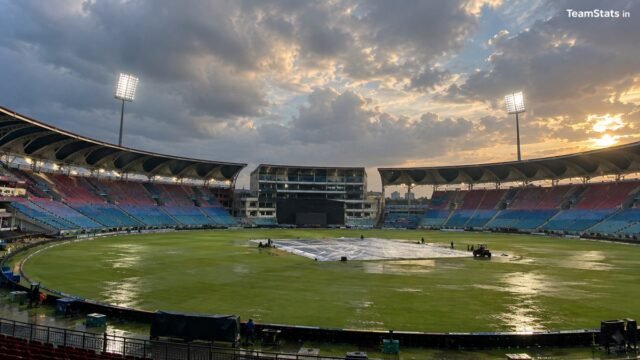
Ekana Cricket Stadium Weather: Lucknow Ground Weather Forecast for IND vs WI 1st T20I