
Dubai International Cricket Stadium Pitch Report Today: T20 Records, Average Score & WCL 2026 Stats
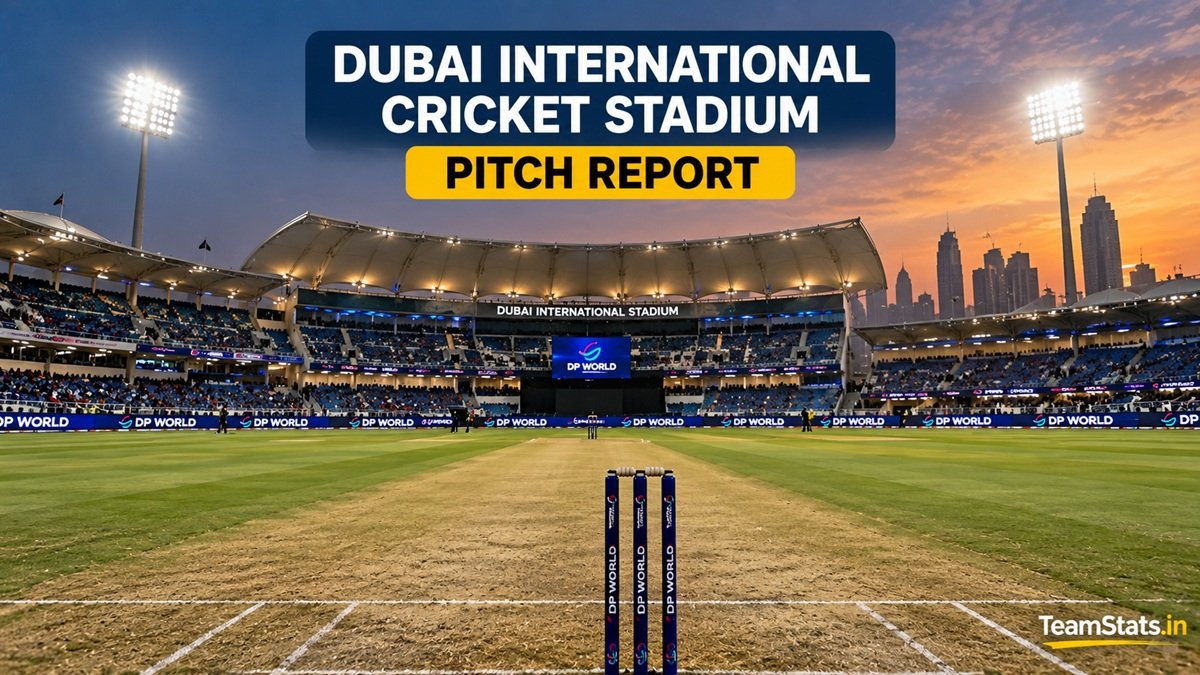
The Dubai International Cricket Stadium Pitch Report points towards a surface where neither batters nor bowlers can simply dominate from the start. Recent and historical T20 numbers suggest that Dubai generally rewards batters who take time to understand the pace of the wicket, while fast bowlers can find assistance with the new ball and spinners become increasingly important through the middle overs.
For T20 cricket, a first-innings score around 160 can be competitive, but the actual par total changes considerably with the competition, pitch used and amount of dew. Broader T20 records at the venue put the average first-innings score close to 147–148, while recent franchise competitions such as ILT20 have produced first-innings averages above 160.
That distinction will be especially important during WCL 2026, when Dubai International Cricket Stadium hosts six matches across October 9, 10 and 11. With two games scheduled on each of those days, pitch allocation, surface wear and evening dew could all have a major influence on how individual matches play.
| Dubai International Cricket Stadium T20 Stats | Record |
|---|---|
| General T20 first-innings average | Around 147–148 |
| General T20 second-innings average | Around 129–131 |
| ILT20 first-innings average | Around 161 |
| ILT20 second-innings average | Around 150 |
| T20I highest team total | India 212/2 |
| T20I lowest team total | West Indies 55 |
| T20I highest individual score | Virat Kohli 122* |
| T20I best bowling | Bhuvneshwar Kumar 5/4 |
| WCL 2026 matches in Dubai | 6 |
| WCL 2026 Dubai dates | October 9–11 |
Dubai International Cricket Stadium Pitch Report: Batting or Bowling Pitch?
The Dubai International Cricket Stadium pitch is best described as balanced rather than a straightforward batting wicket. Batters can score quickly once they adjust to the surface, but the ball does not always arrive perfectly onto the bat, particularly when the pitch becomes dry or has already been used.
Fast bowlers can be dangerous early in the innings. The newer ball can offer bounce and occasional seam movement, making the powerplay an important phase for both teams. Batters who attack without first judging the pace of the wicket can give bowlers opportunities even though the venue is capable of producing big totals.
The nature of the contest can change once the ball becomes older. Cutters, slower deliveries and changes of pace become useful for seamers, while spinners can exploit the grip available from a dry surface through the middle overs.
Venue numbers support the importance of both types of bowling. Pacers have historically taken the larger overall share of T20 wickets at Dubai, but that does not mean spin should be treated as secondary because slower bowlers can be particularly effective at controlling the scoring rate.
For batters, the key is usually adapting rather than attacking at one constant tempo. A side that preserves wickets through the first half of the innings can still accelerate sharply at the death, especially if it has power hitters available for the final five overs.
Dubai International Cricket Stadium Average Score in T20
The Dubai International Cricket Stadium average score needs context because one number cannot accurately describe every T20 competition played here. Across broad T20 datasets, the average first-innings total sits around 147–148, with the second-innings average closer to 129–131.
However, more recent franchise cricket provides a different picture. ILT20 data from Dubai shows a first-innings average around 161, with second innings averaging close to 150, indicating that stronger batting line-ups and modern T20 scoring rates have pushed the practical benchmark higher.
For match-day analysis, therefore, 160–170 is a more useful competitive range than blindly treating 147 as the expected total. A fresh, good batting surface can push the par score towards 175 or beyond, while a dry or heavily used strip can make even 150–160 difficult to chase.
The first six overs often provide the quickest indication of which type of surface is being used. If the ball comes onto the bat cleanly and there is little movement, teams can begin recalculating par upwards; if cutters are gripping and batters are struggling for timing, the expected total needs to come down.
Dubai International Cricket Stadium T20 Records
Dubai has hosted enough high-level T20 cricket to produce a substantial statistical sample rather than conclusions based on only a handful of matches. Historical results show an unusually balanced contest between teams batting first and teams chasing, another indication that the venue cannot simply be labelled a “bat first” or “bowl first” ground.
India’s 212/2 against Afghanistan in September 2022 remains the highest team total in men’s T20 internationals at the venue. At the opposite extreme, West Indies were dismissed for 55 against England in the 2021 T20 World Cup, showing how dramatically scoring conditions and match situations can vary in Dubai.
Virat Kohli’s unbeaten 122 against Afghanistan is the highest individual men’s T20I score at the stadium, while Bhuvneshwar Kumar’s 5/4 in the same match is among its standout bowling performances. Those two records from one game also demonstrate that a good batting surface does not automatically remove bowlers from the contest.
The broader lesson is more useful than any individual record: Dubai can produce 200-plus totals, but it has also produced low-scoring matches where controlling the middle overs becomes decisive.
Dubai Cricket Ground Pitch Report Today: What Should Teams Expect?
The Dubai Cricket Ground Pitch Report for any particular match should begin with the exact strip rather than the venue’s historical average. Dubai has multiple surfaces, and a fresh pitch can behave very differently from one that has already carried significant match traffic.
During the powerplay, batters should generally expect the ball to arrive with more pace than it does later in the innings. Fast bowlers can exploit the harder new ball with back-of-a-length deliveries, while batters have an opportunity to score before the surface becomes slower.
The middle overs are where Dubai frequently becomes tactically interesting. Spinners can change pace and trajectory, while seamers using cutters can make clean hitting more difficult if the ball starts gripping.
Death-over scoring depends heavily on wickets in hand. Because boundaries remain accessible to powerful hitters, a team sitting at 115–120 after 15 overs with six or seven wickets remaining can still finish around 170 or higher.
That is why the Dubai International Stadium Pitch Report should not be reduced to a simple “batting pitch” or “bowling pitch” label. The same surface can favour pace early, spin through the middle and aggressive batting late in the innings.
Does the Toss Matter at Dubai International Cricket Stadium?
The toss matters in Dubai, but historical results do not justify treating chasing as an automatic advantage. Broader T20 records show batting-first and batting-second win percentages relatively close to one another.
What can change the equation is dew. During night matches, moisture on the outfield can make the ball more difficult for bowlers to grip, potentially reducing the effectiveness of spin and slower deliveries during the second innings.
That can encourage captains to bowl first when significant dew is expected. Knowing the target also gives the chasing side greater clarity about the required scoring rate, particularly on a surface where the pace can change as the game develops.
But conditions should determine the decision. On a dry surface expected to slow significantly, putting runs on the board can still be valuable, particularly if the first innings is being played on the better version of the wicket.
Dubai International Cricket Stadium Boundary Length
The Dubai International Cricket Stadium boundary length is another frequently searched factor, but there is no single permanent measurement that accurately represents every match. Boundary ropes can be moved depending on the competition, pitch position and playing regulations.
The square boundaries can consequently differ from one side of the wicket to the other, while straight boundaries also change according to which central strip is being used. Any exact boundary number published days before a match should therefore be treated cautiously unless it refers to the actual rope placement for that fixture.
From a tactical perspective, the uneven dimensions matter more than one generic measurement. Batters frequently target the shorter side, while captains can protect it by changing bowling angles and placing boundary riders accordingly.
This becomes particularly important against powerful hitters. Bowlers who repeatedly miss their intended line towards the shorter boundary can be punished even on a surface that is otherwise helping them.
Dubai International Cricket Stadium Pitch Report for WCL 2026
Dubai becomes particularly important during the middle stage of the World Championship of Legends 2026, with six league matches scheduled at the stadium over three consecutive days. The tournament moves to Dubai on October 9 before returning to Sharjah after the October 11 fixtures.
October 9 features Australia Champions vs South Africa Champions followed by Bangladesh Champions vs West Indies Champions. On October 10, England Champions vs South Africa Champions is followed by the headline India Champions vs Pakistan Champions clash.
The Dubai leg concludes on October 11 with Australia Champions vs West Indies Champions and India Champions vs Bangladesh Champions. Readers following the tournament can check the complete World Championship of Legends 2026 schedule for the full list of matches, dates and venues.
Pitch usage will be worth watching carefully across those three days. Even if different strips are prepared for the double-headers, six matches in such a short period give teams more current evidence about how the venue is behaving than historical averages alone can provide.
The first Dubai match on October 9 will therefore be particularly valuable for updating this Dubai International Cricket Stadium Pitch Report. Once the surface has been seen under WCL conditions, the actual pace, bounce, spin and scoring pattern can be compared with the venue’s broader T20 numbers.
Dubai’s evening matches may also create a different tactical challenge from the afternoon fixtures. Temperature, humidity and dew can alter how easily bowlers grip the ball, so the same venue could produce noticeably different conditions across the two games of a double-header.
Pace vs Spin at Dubai International Cricket Stadium
Historical T20 data gives fast bowlers the larger share of wickets at Dubai. One major venue dataset puts the pace share at roughly 58% of wickets, compared with around 42% for spin, although the precise figures vary depending on which competitions and matches are included.
That should not be interpreted as evidence that the pitch is poor for spinners. Pacers bowl a significant share of the powerplay and death overs, when wickets are naturally more likely because batters are taking greater risks.
Spin can be particularly influential between overs seven and fifteen. When the surface is dry, the ball can grip enough to make attacking against the turn difficult, and experienced slow bowlers can force batters to hit towards the larger areas of the ground.
For WCL cricket, this could become even more significant because experienced former internationals often rely heavily on changes of pace and game awareness. Teams with quality spinners and seamers capable of bowling cutters may therefore be better equipped if Dubai produces a slower surface.
What Is a Good Score at Dubai International Cricket Stadium?
A score of 160–170 should be considered a sensible starting benchmark for a T20 at Dubai rather than a guaranteed par score. Current franchise-era scoring suggests that this range is more relevant to modern T20 cricket than the lower long-term historical average alone.
On a fresh batting pitch, 175–185 can become the more realistic target, especially if the powerplay produces 50 or more without significant wicket damage. Teams with strong finishers can push beyond 190 when the ball continues coming onto the bat.
On a slow or used wicket, however, 150–160 can become highly competitive. If batters are struggling to hit through the line and spin is gripping, attempting to force a 180-type total can create unnecessary wickets.
Anything above 180 should generally put the batting side in a strong position, but Dubai’s history also shows why no total should be judged without considering dew and the exact pitch. A wet ball under lights can substantially change the difficulty of defending even a strong first-innings score.
The best live indicator is therefore the opening innings itself. Watch the amount of new-ball movement, how easily batters hit through the line, whether spin grips, and whether slower balls stop in the surface before deciding what constitutes a genuinely good total.
Dubai International Cricket Stadium Pitch Report – Final Verdict
The Dubai International Cricket Stadium Pitch Report suggests a balanced T20 venue where conditions can change significantly through an innings. Pace bowlers can make an impact with the new ball, spinners and cutters become valuable as the surface gets older, and batters who preserve wickets can still score heavily during the final overs.
Long-term T20 numbers place the first-innings average around 147–148, but recent franchise cricket indicates a higher modern scoring environment, with ILT20 first innings averaging around 161. For upcoming matches, a working benchmark of 160–170 is therefore more useful, with 180-plus representing a strong score under normal conditions.
The toss should be assessed alongside the exact strip and expected dew rather than historical win percentages alone. A dry surface that is likely to slow can favour batting first, while significant evening dew can make chasing considerably more attractive.
For WCL 2026, the most useful evidence will arrive between October 9 and 11 when six matches are played at Dubai International Cricket Stadium. This page should be updated after the first Dubai fixture so the historical numbers can be combined with the latest WCL pitch behaviour.

Related Posts

Sharjah Cricket Stadium Pitch Report Today: T20 Records, Average Score & WCL 2026 Stats
Korogi Sports Park Pitch Report Today: Average Score, T20 Records & Batting or Bowling Pitch

Dubai International Cricket Stadium Weather Today: Rain Forecast, Temperature & WCL 2026 Conditions
IND vs WI Pitch Report: Ekana Cricket Stadium Pitch Report for 1st T20I

South Africa vs Australia Pitch Report, 3rd ODI: JB Marks Oval Potchefstroom Pitch, Records & Conditions