
Sharjah Cricket Stadium Pitch Report Today: T20 Records, Average Score & WCL 2026 Stats
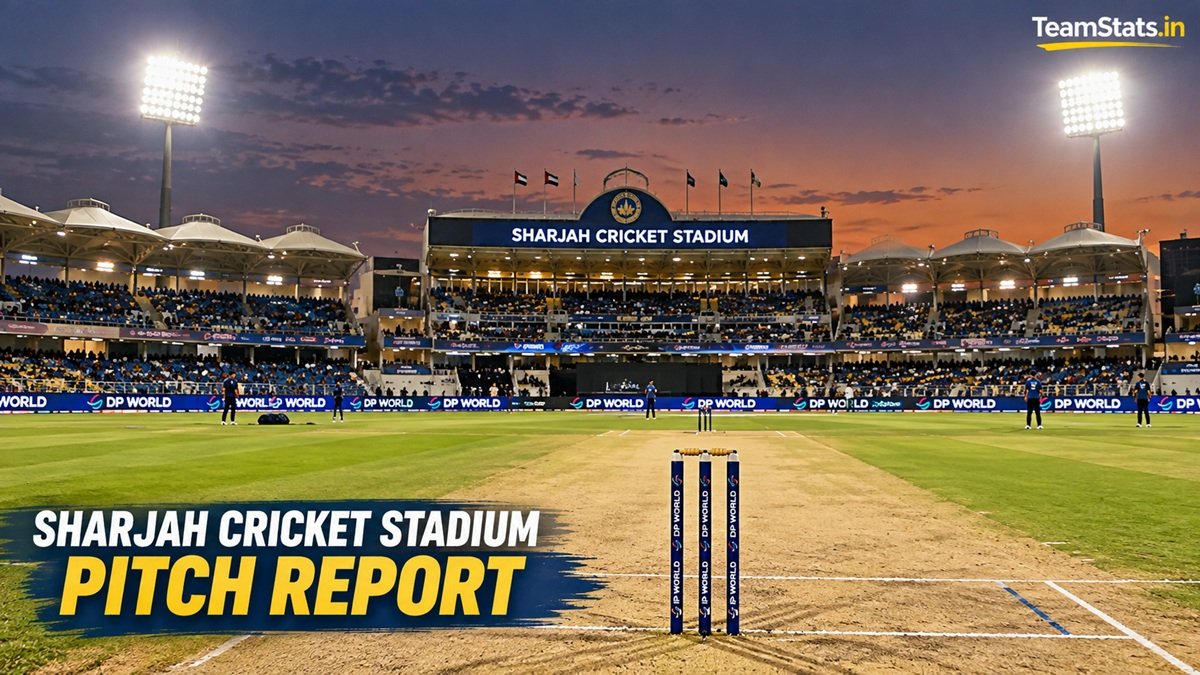
The Sharjah Cricket Stadium Pitch Report suggests a surface where batting can become productive once players adjust to the pace of the wicket, but bowlers remain firmly in the contest. Recent T20 numbers show an average first-innings score of around 167, while teams batting second have averaged close to 149 across the latest 30-match sample.
Sharjah’s relatively compact dimensions can make boundary-hitting look easier than at many larger venues, but the pitch itself does not always produce straightforward high-scoring cricket. The new ball can offer something to the faster bowlers before the surface becomes slower, bringing cutters, changes of pace and spin into the game.
For anyone following the Sharjah Cricket Ground Pitch Report during WCL 2026, the biggest takeaway is that this is not a venue where one fixed formula works every night. The condition of the particular strip, the amount of cricket played on it and how quickly batters adapt can significantly change what represents a competitive T20 total.
| Sharjah Cricket Stadium T20 Data | Recent numbers |
|---|---|
| Average 1st innings score | 167 |
| Average 2nd innings score | 149 |
| Batting-first win rate | 57% |
| Average sixes per match | 15.4 |
| Average fours per match | 21.8 |
| Pace economy | 8.94 |
| Spin economy | 6.93 |
| Pace wicket share | 55% |
| Spin wicket share | 39% |
The figures above are based on the latest 30 completed matches in the recent venue dataset, excluding rain-affected matches.
Sharjah Cricket Stadium Pitch Report: Batting or Bowling Pitch?
The Sharjah Cricket Stadium pitch can be described as balanced rather than purely batting-friendly or bowling-friendly. Recent matches have produced enough runs for aggressive batting to be rewarded, with the first innings averaging 167, but the difference between first and second-innings scoring shows why simply looking at Sharjah’s short boundaries can be misleading.
Fast bowlers can be particularly important with the new ball. Hard lengths, variations and cutters can become effective as the innings develops, while bowlers who repeatedly miss their lengths risk being punished because clearing the boundary does not require the same power as it does at some bigger international grounds.
Spin becomes another major factor once the surface begins to grip. In the recent 30-match dataset, spinners have conceded only 6.93 runs per over compared with 8.94 for pace bowling. Pacers have still taken the larger share of wickets, so the numbers point towards a venue where both bowling styles can succeed for different reasons.
That makes the middle overs particularly important. Batters who are comfortable rotating strike against spin can prevent the innings from stalling, while teams relying almost entirely on boundary hitting may find scoring more difficult if the pitch becomes slower.
Sharjah Cricket Stadium Average Score in T20
A first-innings total in the 160–170 range is a useful starting benchmark under recent Sharjah conditions. The latest 30-match sample has produced an average first-innings score of 167, compared with approximately 149 in the second innings.
However, an average should not automatically be treated as a par score for every match. Recent venue data shows substantial variation between games, with some surfaces allowing totals beyond 180 while other matches have become much more difficult for batters.
The last 10 completed T20 matches provide a similar picture, with an average score around 161. In that sample, three first-innings totals were below 140, four landed between 140 and 180, and three went beyond 180. That spread is one of the clearest indications that the Sharjah Cricket Ground Pitch Report needs to be judged alongside the specific strip being used on match day.
For a normal T20 game, 160–170 can therefore be competitive, while 180-plus becomes a strong total if the surface is beginning to slow. On a fresh batting strip, however, teams may need considerably more because Sharjah’s dimensions allow set batters to accelerate rapidly.
Sharjah Cricket Stadium T20I Records
The longer-term T20I numbers are slightly different from the recent all-T20 trend, which is why they should be viewed separately.
| T20I Record | Sharjah |
|---|---|
| Recent 30 T20I average 1st innings | 160 |
| Recent 30 T20I average 2nd innings | 134 |
| Batting-first win rate | 57% |
| Chasing win rate | 43% |
| Average sixes per match | 13.1 |
| Average fours per match | 20.3 |
| Pace economy | 8.26 |
| Spin economy | 6.48 |
These figures reinforce one important feature of the Sharjah Cricket Stadium Pitch Report: spin can be economical even when pace bowlers collect more wickets. In the recent T20I sample, pace has accounted for 57% of wickets compared with 37% for spin, but spinners have conceded substantially fewer runs per over.
Historical databases can show lower averages because they cover a much wider period and different competitions. That is why an old venue average should not automatically be used to predict a WCL 2026 match played under current conditions.
Sharjah Cricket Ground Pitch Report Today: What Should Teams Expect?
The opening powerplay provides perhaps the best batting opportunity if the ball is coming onto the bat cleanly. At the same time, it is also the phase when seamers have their best opportunity to find movement, meaning aggressive batting carries genuine wicket-taking risk.
Once the ball gets older, pace-off deliveries become increasingly useful. Batters who wait for the ball and target particular boundary areas generally have a better chance than those trying to manufacture every shot against a slowing surface.
Spin can then control the middle overs. The recent economy numbers make that especially clear, and wrist-spinners or accurate finger-spinners capable of changing their pace can force batters to take risks rather than simply hitting through the line.
The final five overs can still change the score dramatically because of the ground dimensions. A side reaching 130–140 with wickets available after 15 overs can potentially push well beyond 170, so wickets in hand remain extremely valuable at Sharjah.
Does the Toss Matter at Sharjah?
Recent results do not show an overwhelming advantage for either strategy. Across the latest 30-match sample, teams batting first have won approximately 57% of matches, suggesting that putting a competitive total on the board has worked slightly more often.
That does not mean the captain winning the toss should automatically bat first. Evening conditions, dew, the exact pitch being used and the strength of each team’s bowling attack can all influence the decision.
If the surface looks dry and likely to become progressively slower, batting first becomes attractive because chasing against spin and pace-off bowling can become difficult. If dew is expected to make gripping the ball harder later in the night, bowling first becomes the more logical option.
For WCL matches in particular, the toss should therefore be treated as one part of the pitch assessment rather than the entire prediction.
Sharjah Cricket Stadium Boundary Length
Sharjah has long carried a reputation for relatively short boundaries, which is one reason power hitters are so closely associated with the venue. Published ground estimates vary depending on the playing area and boundary rope used for a particular match, so there is no single permanent measurement applicable to every fixture.
Commonly reported dimensions place some boundaries roughly in the high-50s to mid-60-metre range. The rope can be moved between competitions and matches, meaning the actual match-day dimensions are more useful than a historical fixed number.
The smaller playing area does not automatically make every Sharjah match high-scoring. A slow pitch can reduce timing considerably, forcing batters to generate their own pace and giving bowlers using cutters and spin an opportunity to defend relatively modest totals.
This combination of compact boundaries and a surface capable of slowing down is what makes Sharjah tactically different. Six-hitting is always available, but poor shot selection can be punished just as quickly.
Sharjah Cricket Stadium Pitch Report for WCL 2026
Sharjah is one of the key venues for the World Championship of Legends 2026, making its pitch conditions particularly important during the opening phase of the tournament. Several league matches are being played at the venue in a short period, increasing the possibility that different strips will be used and that individual surfaces may behave differently as the competition progresses.
Sharjah is at the centre of the early WCL action, and the India Champions vs Australia Champions scorecard has already provided the first useful look at how the surface is playing this season. More matches at the venue will help build a clearer picture, with South Africa Champions vs West Indies Champions and India Champions vs England Champions adding fresh evidence about scoring conditions, spin and pace as the tournament progresses. Readers following every Sharjah fixture can also check the complete World Championship of Legends 2026 schedule for the upcoming matches and dates.
The early WCL schedule has already put Sharjah at the centre of the tournament. India Champions opened their campaign here against Australia Champions, while South Africa Champions vs West Indies Champions and India Champions vs England Champions are among the October 4 fixtures at the venue.
The workload on the square is worth monitoring throughout WCL 2026. If matches continue to be played regularly at Sharjah, used surfaces could become progressively slower, potentially increasing the importance of spin, cutters and batters capable of manipulating the field rather than relying only on power.
For that reason, the Sharjah Cricket Stadium Pitch Report Today should be updated after every major WCL match. Recent match scores, the behaviour of the new ball and how much assistance spinners receive will provide a much stronger guide than relying solely on historical venue records.
What Is a Good Score at Sharjah Cricket Stadium?
Based on recent T20 evidence, around 165–170 should be considered a competitive first-innings benchmark, rather than an automatic winning score. Anything above 180 can put significant pressure on a chasing side when the surface is slow, while a particularly good batting pitch can push the required target considerably higher.
A total around 150 should not immediately be dismissed either. If the ball is gripping, stroke-making is becoming difficult and there is little dew, disciplined bowling can make such a score defendable.
The first six overs often provide the clearest indication of the day’s conditions. If batters are timing the ball easily through the line, expectations can move towards 180 or more; if the new ball is stopping in the surface and slower deliveries are already effective, the realistic par score should be adjusted downwards.
That match-specific reading is ultimately more valuable than treating Sharjah as permanently batting-friendly or permanently slow.
Sharjah Cricket Stadium Pitch Report – Final Verdict
The Sharjah Cricket Stadium Pitch Report points towards a balanced T20 venue where batters can score quickly because of the ground dimensions, but bowlers remain influential throughout the innings. Recent evidence puts the first-innings average around 167, with teams batting first winning 57% of the latest 30 completed matches.
Pacers can attack early and continue to take wickets through variations, while spinners become particularly valuable when the surface begins to slow. The recent difference between pace and spin economy rates also shows why a strong spin attack can control the middle overs even when fast bowlers finish with more wickets.
For the Sharjah Cricket Ground Pitch Report, a score around 165–170 is a sensible current benchmark, with 180-plus potentially becoming a strong total on a slower surface. WCL 2026 brings multiple matches to Sharjah, so the most reliable assessment will come from combining these venue trends with the condition of the exact strip being used on the day.

Related Posts

Dubai International Cricket Stadium Pitch Report Today: T20 Records, Average Score & WCL 2026 Stats
Korogi Sports Park Pitch Report Today: Average Score, T20 Records & Batting or Bowling Pitch
IND vs WI Pitch Report: Ekana Cricket Stadium Pitch Report for 1st T20I

South Africa vs Australia Pitch Report, 3rd ODI: JB Marks Oval Potchefstroom Pitch, Records & Conditions

Bangladesh vs Malaysia Pitch Report: Korogi Sports Park Records, Weather & Asian Games 2026