
India vs Japan T20I Today: Match Time, Playing XI, Weather, Squads & Latest Updates

India vs Japan T20I Today: Historic First Meeting Before Asian Games 2026
India and Japan will create a small piece of cricket history today when their men’s national teams meet for the first time in an international match. The one-off T20I will be played at the Sano International Cricket Ground in Tochigi on September 22, giving Shreyas Iyer’s side its final competitive test before turning attention towards the Asian Games 2026.
The match is officially being played as the Suzuki Cup, rather than as part of the Asian Games cricket tournament itself. However, the timing makes the Asian Games connection important. Japan are using the contest to test themselves against one of world cricket’s strongest teams, while India have an opportunity to assess combinations before beginning their Asian Games title defence.
There is another reason the India vs Japan T20I today could attract considerable attention in India: Vaibhav Sooryavanshi is part of the touring squad. The young batter did not get an opportunity during the recent Afghanistan series, making his possible appearance against Japan one of the biggest selection stories before the toss.
India vs Japan Match Today: Key Details
| Detail | Information |
|---|---|
| Match | Japan vs India |
| Match type | One-off T20I |
| Trophy | Suzuki Cup 2026 |
| Date | September 22, 2026 |
| Venue | Sano International Cricket Ground, Tochigi |
| Official local start | 1:00 PM |
| India time | 9:30 AM IST |
| India captain | Shreyas Iyer |
| Japan captain | Kendel Kadowaki-Fleming |
The occasion goes beyond preparations for another tournament. The fixture is part of celebrations marking 75 years of diplomatic relations between India and Japan and is connected with the wider “Sport 75” initiative. More importantly from a cricket perspective, it gives Japan’s men’s team a rare opportunity to face an established Full Member side on home soil.
Why India vs Japan Is a Historic Match
India and Japan have never previously met in a men’s international cricket match. That alone makes today’s contest unusual, particularly at a time when cricket is attempting to expand its reach beyond its traditional markets.
For Japan, facing India provides exposure that ordinary bilateral fixtures cannot easily replicate. Kendel Kadowaki-Fleming’s side will be playing against a squad containing internationally established names such as Shreyas Iyer, Jasprit Bumrah, Arshdeep Singh, Abhishek Sharma, Tilak Varma and Axar Patel. Even if the difference in international experience is substantial, the match gives Japan a valuable benchmark before its next major assignments.
India have a different objective. Results will obviously matter, but the team management can also use the match to examine combinations, give opportunities to players who need game time and assess how the squad responds to unfamiliar conditions in Japan.
Vaibhav Sooryavanshi Could Be the Player Everyone Watches
One of the biggest questions before the toss is whether Vaibhav Sooryavanshi gets an opportunity in the XI. The young left-handed batter is included in India’s squad and his selection has naturally generated interest because of the attacking reputation he has already developed at a very young age.
India have several options at the top of the order, so his inclusion cannot simply be assumed before the official XI is announced. However, a one-off match against Japan provides a logical opportunity for the team management to give younger members of the squad competitive exposure before the Asian Games.
If Vaibhav does play, his approach could become one of the most watched parts of the match. India’s objective would not simply be to see how many runs he scores, but also how he responds to an unfamiliar venue and the pressure that comes with representing the senior national side.
Shreyas Iyer Leads a Strong India Squad
Shreyas Iyer will captain India in Sano, with the selectors naming a squad that combines established international players with younger options. Abhishek Sharma and Tilak Varma provide attacking batting, while Sanju Samson and Ishan Kishan give India two experienced wicketkeeping options.
The all-round department offers considerable flexibility through Axar Patel, Washington Sundar and Shivam Dube. India also have substantial bowling experience available, with Jasprit Bumrah and Arshdeep Singh capable of leading the pace attack and Ravi Bishnoi providing a frontline spin option.
Vipraj Nigam is also part of the squad after Varun Chakravarthy was ruled out with a side strain. That gives India another potential option if the management wants to use the Japan match to test players before settling on combinations for the Asian Games.
India Squad for Japan T20I
| Role | Players |
|---|---|
| Captain | Shreyas Iyer |
| Wicketkeepers | Sanju Samson, Ishan Kishan |
| Batters | Abhishek Sharma, Tilak Varma, Vaibhav Sooryavanshi |
| All-rounders | Shivam Dube, Axar Patel, Washington Sundar |
| Spin | Ravi Bishnoi, Vipraj Nigam |
| Pace | Jasprit Bumrah, Arshdeep Singh, Yash Thakur |
The presence of several established players means India are not treating the fixture purely as an experimental game. At the same time, the one-off format gives the management limited time to assess fringe combinations, so the final XI could reveal something about India’s thinking ahead of the Asian Games.
Japan Have Their Own Opportunity
Japan will be led by Kendel Kadowaki-Fleming, one of the country’s most important T20 batters. The squad also includes Shirai Patmore, Alester Fleming, Benjamin Ito Davis, Reo Sakurano Thomas and a group of players who will gain valuable experience from facing a significantly stronger international opponent.
The result is not the only meaningful measure for Japan. Facing India’s pace, spin and batting depth provides a level of preparation that is difficult to recreate in training. A competitive period of four or five overs with either bat or ball could provide useful information before Japan’s upcoming tournament commitments.
Home conditions may also help Japan settle faster than their opponents. India have travelled into unfamiliar conditions, while Japan’s players should have a better understanding of how the Sano surface and outfield behave.
Japan Squad
Kendel Kadowaki-Fleming (c), Shirai Patmore (wk), Alester Fleming, Benjamin Ito Davis, Reo Sakurano Thomas, Kohei Kubota, Wataru Miyauchi, Declan Suzuki, Ibrahim Takahashi, Makoto Taniyama, Lachlan Yamamoto-Lake, Tsuyoshi Takada, Charlie Hara-Hinze, Shoma Slater and Jake Kusuda-Nairn.
Japan’s squad is also closely connected with their Asian Games preparations, making today’s match far more useful than a ceremonial exhibition. The players have an opportunity to experience the pace and tactical demands of a high-level international side before moving deeper into a major multi-sport tournament.
Rain Could Become the Biggest Match-Day Concern
The weather in Sano has emerged as an important story before the match. Heavy rain associated with Typhoon Dujuan affected eastern Japan ahead of the fixture, and India’s scheduled training session on Monday was reportedly cancelled because of the weather and wet outfield.
Conditions are expected to improve compared with the preceding period, but the possibility of showers means the ground staff and outfield could remain important factors. Even without sustained rain during the match, moisture from earlier weather can influence how quickly the outfield plays and how the surface behaves early in the innings.
For India, the cancelled training session is particularly relevant because the team has had limited opportunity to familiarise itself with the venue. Japan should naturally possess greater local knowledge, although the difference in overall international experience remains considerable.
Sano Conditions Add an Unknown Element
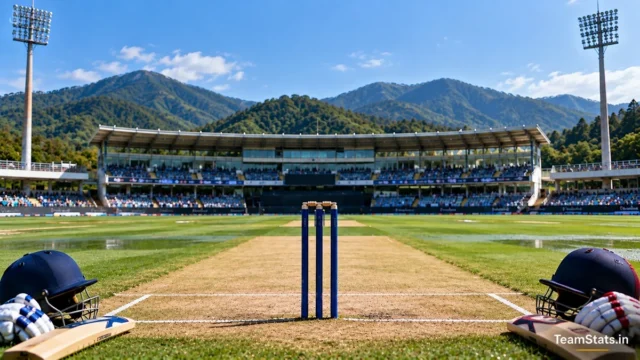
Sano International Cricket Ground is not a venue where India’s senior men’s team regularly plays, so there is less relevant top-level data than there would be for a major ground in India, Australia or England. That makes observations around the toss particularly important.
Recent rain could encourage the captain winning the toss to consider how much moisture remains in the surface and outfield. If there is assistance with the new ball, India’s experienced pace attack could become especially difficult to handle. On the other hand, a slower surface could bring the spinners and cutters into the match.
Rather than making firm claims about a conventional “batting pitch” or “bowling pitch” before seeing the match-day surface, the more useful indicators will be conditions at the toss, recent rain and how the ball behaves during the opening overs.
What India Can Learn Before the Asian Games
India’s main benefit from this match is competitive preparation. Training sessions can help players adjust physically, but a T20I forces the side to make decisions under match pressure, something particularly valuable immediately before a major tournament.
The batting order is one area worth watching. India have Abhishek Sharma, Sanju Samson, Ishan Kishan and Vaibhav Sooryavanshi as possible top-order options, while Shreyas and Tilak provide experience through the middle. How those positions are arranged could provide an early indication of the combinations India want to explore in Japan.
Bowling combinations will be equally interesting. Bumrah and Arshdeep provide obvious new-ball quality, but players such as Bishnoi, Washington and Vipraj could use the match to strengthen their case for larger roles as conditions and opposition change during the Asian Games.
Three India Players to Watch
Vaibhav Sooryavanshi
The selection question alone makes Vaibhav one of the most interesting names around the match. If included, the young batter will have an opportunity to translate his attacking domestic and age-group reputation into a senior international environment.
Abhishek Sharma
Abhishek gives India another naturally aggressive option at the top. His ability to score quickly during the powerplay could make him particularly useful if India want to establish control immediately against Japan.
Jasprit Bumrah
Bumrah provides the opposite end of India’s experience spectrum. Japan’s batters rarely get the opportunity to face a bowler of his international pedigree, so any spell involving Bumrah could become one of the most demanding passages of the match for the hosts.
Japan Player to Watch: Kendel Kadowaki-Fleming
Japan captain Kendel Kadowaki-Fleming carries significant responsibility in a historic home fixture. As one of Japan’s leading T20 run-scorers, he will be central to their chances of constructing a competitive innings against India’s bowling attack.
His challenge will be particularly demanding if India use Bumrah and Arshdeep with the new ball. Rather than attempting to match India’s aggression immediately, Japan may benefit more from preserving wickets and ensuring their experienced batters remain at the crease long enough to create a platform.
A meaningful contribution from the captain would also give the home crowd a focal point in a match that represents a significant occasion for Japanese cricket.
India vs Japan Is Bigger Than a One-Off Result
The competitive gap between the two cricket systems makes India the much more experienced side, but the broader importance of the fixture lies elsewhere. Japan gets a rare home international against one of cricket’s biggest nations, while India gets competitive preparation in Japanese conditions ahead of the Asian Games.
The match also arrives as cricket continues expanding into new markets. Japan is not traditionally associated with the sport in the way India is, but major international fixtures can help introduce the game to new audiences and provide local players with exposure that domestic competition cannot reproduce.
That context is why the India vs Japan T20I today is more interesting than an ordinary one-off match. It combines international cricket, Asian Games preparation, a first-ever meeting between the two men’s teams and the possibility of seeing some of India’s younger players given an opportunity.
What to Watch Before the First Ball
The confirmed India XI will be the first major update. Vaibhav Sooryavanshi’s inclusion, India’s wicketkeeping choice and the balance between pace and spin are all worth monitoring once the teams are announced.
Weather is the second major factor. The build-up has already been affected by rain, so conditions at Sano International Cricket Ground could influence the toss and early stages even if the match starts on schedule.
Above everything else, today’s contest marks a first. India and Japan have never previously met in men’s international cricket, and their first encounter comes just as both teams are preparing for another important phase of cricket in Japan.
For Shreyas Iyer’s India, the Suzuki Cup offers one final opportunity to sharpen combinations before the Asian Games. For Kendel Kadowaki-Fleming and Japan, it is a rare chance to test themselves against elite international opposition on home soil. That makes September 22 a significant day regardless of what the final scorecard eventually shows.

Related Posts
Ghana vs Sierra Leone Today: Live Score, Match Time, Playing XI, H2H & Quadrangular T20I Series 2026 Updates
South Africa vs Australia 1st ODI Today: Playing XI, Match Time, Kingsmead Pitch Report & Latest Updates
India vs Japan Pitch Report Today: Sano International Cricket Ground Conditions for Historic T20I
India Women vs Sri Lanka Women Asian Games 2026 Final Today: Match Time, Key Battles & Latest Updates

India National Cricket Team vs West Indies Cricket Team Players: 2026 Full ODI & T20I Squads, Captains and Key Names