Vaibhav Sooryavanshi Duleep Trophy Record: He Broke One, But Sachin Tendulkar’s Survived by Just 8 Runs
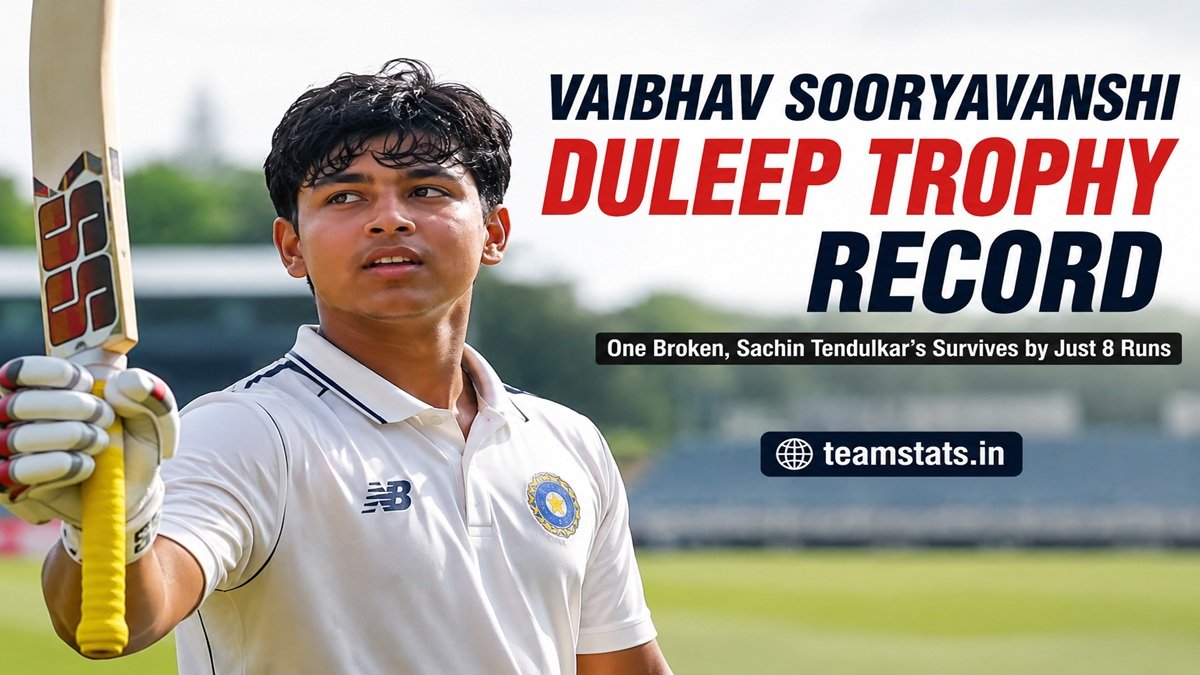
Vaibhav Sooryavanshi Duleep Trophy Record: 57-Year Mark Falls, Another Escapes by 8 Runs
Vaibhav Sooryavanshi walked into the Duleep Trophy record books on Monday, but his 81-ball stay in Bengaluru came remarkably close to rewriting two major records instead of one.
Opening for East Zone against Central Zone in the 2026 Duleep Trophy semifinal, Sooryavanshi raced to his half-century from just 42 balls. That fifty made him the youngest player ever to reach the landmark in Duleep Trophy history.
The record he erased had survived for 57 years.
But the more remarkable part came afterwards.
Sooryavanshi kept going.
Sixty became seventy. Seventy became eighty. Then he entered the nineties with another piece of Duleep Trophy history suddenly within reach.
At 92, however, the run stopped.
Harsh Dubey dismissed him with Arshad Khan completing the catch, leaving Sooryavanshi eight runs short of a century. His final numbers were spectacular: 92 from 81 balls, seven fours and seven sixes.
Those missing eight runs mattered for more than a personal hundred.
Had Sooryavanshi reached 100, he would also have broken Sachin Tendulkar’s record as the youngest centurion in Duleep Trophy history. Tendulkar has held that distinction since the 1990-91 season.
So this wasn’t simply a 92.
It was an innings in which one long-standing Duleep Trophy record disappeared — and another survived by only eight runs.
- Vaibhav Suryavanshi runs in IPL 2026
- Vaibhav Suryavanshi Sixes in IPL 2026: 72 Sixes From 327 Balls
- Vaibhav Suryavanshi 190 Runs: The Record-Breaking in Vijay Hazare
- Vaibhav Sooryavanshi Duleep Trophy Bowling: 2 Wickets in 4 Balls
- Latest Vaibhav Suryavanshi News
- Shere Punjab Cricket League 2026 Latest Update
- Vaibhav Sooryavanshi Duleep Trophy Captain
- Duleep Trophy stats 2026-2027
Vaibhav Sooryavanshi Duleep Trophy Record Explained
For anyone searching specifically for the Vaibhav Sooryavanshi Duleep Trophy record, here is the simplest explanation.
| Record | Detail |
|---|---|
| Record broken | Youngest player to score a Duleep Trophy fifty |
| Vaibhav’s age | 15 years, 157 days |
| Previous holder | Laxman Singh |
| Previous record age | 16 years, 23 days |
| Previous record set | 1969 |
| How quickly Vaibhav reached 50 | 42 balls |
| Final score | 92 off 81 balls |
| Boundaries | 7 fours, 7 sixes |
| Record narrowly missed | Youngest Duleep Trophy centurion |
| Current holder of century record | Sachin Tendulkar |
| Tendulkar’s age at century | 17 years, 262 days |
| Runs Vaibhav needed | 8 more |
Sooryavanshi’s record-breaking fifty came during East Zone’s first-innings response to Central Zone’s 266 at the BCCI Centre of Excellence Ground 1 in Bengaluru.
The Record Had Survived Since 1969
To understand why Sooryavanshi’s achievement matters, it helps to go back more than half a century.
Before Monday, Laxman Singh held the record for the youngest player to score a fifty in the Duleep Trophy.
Singh was 16 years and 23 days old when he reached the landmark in the 1968-69 season.
That record survived generation after generation.
India produced Sachin Tendulkar.
Rahul Dravid arrived.
Then came Virender Sehwag, Yuvraj Singh and a long list of young domestic stars.
The Duleep Trophy itself changed formats several times.
Yet the age record remained.
Until Sooryavanshi.
At 15 years and 157 days, he lowered the benchmark substantially and became the first player younger than 16 to register a Duleep Trophy half-century.
Youngest Players to Score a Duleep Trophy Fifty
The comparison makes Sooryavanshi’s achievement clearer.
| Player | Age when scoring Duleep Trophy fifty |
|---|---|
| Vaibhav Sooryavanshi | 15 years, 157 days |
| Laxman Singh | 16 years, 23 days |
| Piyush Chawla | 16 years, 307 days |
Laxman Singh had occupied the top position since 1969, while Piyush Chawla also features among the youngest players to achieve the landmark.
Sooryavanshi didn’t edge past the old record by a few days.
He moved the benchmark into an entirely new age bracket.
He Reached the Record With a Six
There was nothing particularly cautious about the shot that created history.
Sooryavanshi reached his fifty from 42 deliveries by launching off-spinner Saransh Jain for six.
At the moment he completed the half-century, he had already struck five fours and three sixes.
It was a fitting way for a batter known for aggressive strokeplay to claim the record.
But what happened after fifty is arguably more important to understanding the innings.
He didn’t stop at the milestone.
Sooryavanshi continued building.
His eventual 92 contained seven fours and seven sixes, meaning 70 of his 92 runs came in boundaries.
That’s approximately 76% of his total score.
Yet he still faced 81 deliveries.
That combination — enormous boundary output without the innings becoming a 25-ball cameo — is what makes the performance interesting from a red-ball perspective.
The 42-Ball Fifty Was Only Half the Story
Looking only at the speed of Sooryavanshi’s fifty can give the wrong impression.
Yes, 42 balls is extremely quick for a first-class half-century.
Yes, he hit seven sixes during the complete innings.
But this wasn’t simply Sooryavanshi attempting to play T20 cricket with a red ball.
There were periods when he defended.
There were periods when he kept the ball on the ground.
And there were periods when Central Zone’s bowlers were allowed to deliver good balls without Sooryavanshi feeling compelled to manufacture a scoring shot.
His scoring pattern illustrates it.
First 50 runs: 42 balls
Next 42 runs: 39 balls
Rather than exploding recklessly after reaching fifty, his scoring rate remained relatively controlled as the century approached.
That matters because Sooryavanshi entered this semifinal with much more to prove in first-class cricket than in limited-overs formats.
One Life on 40 Changed Everything
The record almost never happened.
Sooryavanshi had reached 40 from 28 balls when he offered Central Zone a major opportunity.
A top edge went into the air.
For a moment, Sooryavanshi apparently thought his innings was finished and began moving towards the pavilion.
The catch went down.
He survived.
That dropped opportunity completely changed the morning.
Had the catch been completed, the scorecard would have read 40.
Instead:
40 became 50.
50 became the youngest Duleep Trophy half-century ever.
And eventually 50 became 92.
Central Zone’s mistake ultimately cost another 52 runs.
Then Sachin Tendulkar’s Record Came Into View
This is where Sooryavanshi’s innings becomes much more interesting than the basic “57-year-old record broken” headline.
Once he moved through the eighties and into the nineties, another historic benchmark was suddenly vulnerable.
Sachin Tendulkar is the youngest player to score a century in Duleep Trophy history.
Tendulkar achieved the feat during the 1990-91 Duleep Trophy, when he was 17 years and 262 days old.
Sooryavanshi was more than two years younger.
Had he found eight additional runs, the record table would have changed again.
Instead, Tendulkar’s mark survived.
One Record Broken, One Record Survived
That gives Sooryavanshi’s innings an unusual statistical symmetry.
| Record before the innings | What happened |
|---|---|
| Laxman Singh – youngest Duleep Trophy half-centurion | Broken by Sooryavanshi |
| Sachin Tendulkar – youngest Duleep Trophy centurion | Still stands |
| Sooryavanshi’s final score | 92 |
| Runs needed for the second record | 8 |
This is the detail that makes the innings more fascinating than simply another age record.
At fifty, Sooryavanshi had already made history.
At 92, he was one or two scoring shots away from doing it again.
What Happened at 92?
The century was close enough to become a genuine possibility.
But Sooryavanshi did not abandon his attacking instincts.
On 92, he went after left-arm spinner Harsh Dubey, attempting another aggressive shot towards the leg side.
This time it did not clear the field.
Arshad Khan completed the catch and Sooryavanshi’s innings ended at 92 from 81 deliveries.
The reaction showed what the hundred meant.
Sooryavanshi was visibly frustrated as he left the field after falling eight short of three figures.
But the dismissal should not erase what had happened during the previous 80 deliveries.
He had already broken a Duleep Trophy record that pre-dated the international careers of several generations of Indian greats.
And There Was Another Record Waiting Beyond 100
Even the Tendulkar record wasn’t the full extent of what was at stake.
Had Sooryavanshi reached a century, reports noted that he would also have become the second-youngest Indian to score a first-class hundred.
That broader Indian first-class record belongs to Dhruv Pandove, who scored a century for Punjab against Jammu & Kashmir in the 1988-89 Ranji Trophy season at 14 years and 293 days.
So the difference between 92 and 100 potentially represented three milestones:
Already achieved: youngest Duleep Trophy half-centurion.
Would have achieved at 100: youngest Duleep Trophy centurion.
Would also have achieved: second-youngest Indian first-class centurion.
Eight runs prevented the final two.
The Opening Partnership Was Almost as Important as the Record
Individual records can sometimes distract from the actual match.
That isn’t the case here.
Central Zone had scored 266 in their first innings.
East Zone therefore needed a strong response rather than simply an entertaining cameo from Sooryavanshi.
He opened alongside Abhimanyu Easwaran.
The contrast was intriguing.
At one end was one of India’s most experienced domestic red-ball batters.
At the other was one of its youngest and most aggressive prospects.
Together, they put on a huge opening partnership.
Sources differ slightly on whether the partnership is recorded as 161 or 162 runs, depending on the match-update convention, but the central point is unchanged: the pair wiped away well over half of Central Zone’s first-innings total before Sooryavanshi departed.
That made the 92 valuable beyond the record book.
It changed the position of the semifinal.
92 Is Also Important Because of What Came Before It
There is another statistic that makes this innings worth examining.
Before this semifinal, Sooryavanshi had scored 215 runs from 13 first-class innings at an average of 16.53.
His previous first-class best was 93 for Bihar against Meghalaya.
That means Monday’s 92 was just one run short of his career-best first-class score.
This context matters enormously.
Sooryavanshi has already built a reputation around extraordinary attacking performances.
But his red-ball record had been far more modest.
The question was never:
Can Vaibhav Sooryavanshi hit sixes?
Everyone already knew the answer.
The better question was:
Can that attacking ability survive long enough to produce substantial first-class innings?
Against Central Zone, the answer became a little clearer.
70 of His 92 Runs Came in Boundaries
Here is one statistic that captures just how unusual the innings was.
Sooryavanshi hit:
7 fours = 28 runs
7 sixes = 42 runs
That means:
70 of his 92 runs came through boundaries.
Or approximately:
76.1% of the entire innings.
Only 22 runs came without the ball reaching or clearing the boundary.
But there is another way to interpret those numbers.
The 14 boundaries occupied only 14 of his 81 deliveries.
Across the remaining 67 balls, Sooryavanshi had to defend, leave, rotate strike or wait for another opportunity.
That balance may ultimately be more important to his development than the seven sixes.
The destructive game is already there.
The ability to survive between the destructive moments is what first-class cricket is testing.
Compare This With His Duleep Trophy Debut
The improvement becomes even more obvious when his two matches are placed next to each other.
Sooryavanshi’s first Duleep Trophy batting contribution came against North East Zone in the quarterfinal.
He scored only 8 runs.
East Zone didn’t need a big innings from him because the rest of the batting lineup dominated the match.
Interestingly, Sooryavanshi then contributed with the ball, taking 2/11.
Now look at what followed.
| Duleep Trophy performance | Result |
|---|---|
| Quarterfinal batting | 8 |
| Quarterfinal bowling | 2/11 |
| Semifinal fifty | 42 balls |
| Semifinal final score | 92 off 81 |
| Fours | 7 |
| Sixes | 7 |
| Record | Youngest Duleep Trophy half-centurion |
One match produced almost nothing with the bat.
The next produced a tournament record.
That is quite a turnaround.
The Numbers Behind Vaibhav Sooryavanshi’s 92
Here is the innings stripped down to the key numbers:
| Statistic | Vaibhav Sooryavanshi |
|---|---|
| Runs | 92 |
| Balls | 81 |
| Strike rate | 113.58 |
| Fours | 7 |
| Sixes | 7 |
| Runs in boundaries | 70 |
| Percentage of runs in boundaries | 76.1% |
| Balls to fifty | 42 |
| Score when dropped | 40 |
| Runs added after dropped chance | 52 |
| Runs short of century | 8 |
Those numbers explain why the innings can be viewed from several different angles.
It was explosive.
It was historic.
It was frustratingly incomplete.
And, from a red-ball-development perspective, it may be one of Sooryavanshi’s most informative innings yet.
The Most Important Part of the Record Isn’t His Age
Age will dominate the headlines.
That’s understandable.
Breaking a 57-year-old record at such an early stage of a career is extraordinary.
But if we look beyond the headline, something else may matter more.
Sooryavanshi did not need another innings proving he possesses power.
Seven sixes simply reinforce something cricket already knew.
What he needed was evidence that his natural aggression could coexist with the demands of first-class batting.
Before the semifinal, his numbers left that question open.
The 92 doesn’t close the discussion completely.
One innings never should.
But it changes it.
There were 81 deliveries of evidence rather than a 20-ball burst.
There was a major opening partnership.
There were periods of restraint between the boundaries.
And there was enough time at the crease for Central Zone to change plans and still fail to dismiss him until he reached 92.
That is why this performance could prove more important than the record itself.
Laxman Singh’s Record Is Gone. Tendulkar’s Remains.
Records often reduce complicated performances to one simple number.
For Laxman Singh, that number was 16 years and 23 days.
It survived from 1969 until 2026.
Now the number is 15 years and 157 days, and the name beside it is Vaibhav Sooryavanshi.
Sachin Tendulkar’s Duleep Trophy century record has survived too.
For now.
Tendulkar was 17 years and 262 days when he made his century in the 1990-91 tournament.
The remarkable thing is that Sooryavanshi did not merely threaten that record in theory.
He got to 92.
Eight more runs and another piece of Duleep Trophy history would have changed hands.
Vaibhav Sooryavanshi Duleep Trophy Record: FAQs
What record did Vaibhav Sooryavanshi break in the Duleep Trophy?
Vaibhav Sooryavanshi became the youngest player to score a half-century in Duleep Trophy history. He achieved the landmark at 15 years and 157 days during East Zone’s 2026 semifinal against Central Zone.
Who held the record before Vaibhav Sooryavanshi?
The previous record belonged to Laxman Singh, who scored a Duleep Trophy fifty at 16 years and 23 days in 1969. His mark stood for 57 years.
How many runs did Vaibhav Sooryavanshi score?
Sooryavanshi scored 92 from 81 balls, hitting seven fours and seven sixes against Central Zone.
How many balls did Vaibhav Sooryavanshi take to reach fifty?
He completed his record-breaking half-century from 42 deliveries, reaching fifty with a six off Saransh Jain.
Did Vaibhav Sooryavanshi score a Duleep Trophy century?
No. He was dismissed for 92, falling eight runs short of his century.
Which Sachin Tendulkar record could Vaibhav Sooryavanshi have broken?
A century would have made Sooryavanshi the youngest Duleep Trophy centurion, breaking Sachin Tendulkar’s record. Tendulkar achieved the feat at 17 years and 262 days during the 1990-91 Duleep Trophy.
Would the century have created another first-class record?
It would have made Sooryavanshi the second-youngest Indian to score a first-class century. Dhruv Pandove remains the youngest, having made a first-class hundred at 14 years and 293 days.
Who dismissed Vaibhav Sooryavanshi for 92?
Harsh Dubey dismissed Sooryavanshi, with Arshad Khan completing the catch.
How many sixes did Vaibhav Sooryavanshi hit?
He struck seven sixes and seven fours during his 92-run innings.
Where was the record-breaking innings played?
The innings came at the BCCI Centre of Excellence Ground 1 in Bengaluru during East Zone’s Duleep Trophy semifinal against Central Zone.
One Record Changed Hands. The Other Escaped.
The easiest way to describe Monday’s innings is to say that Vaibhav Sooryavanshi broke a 57-year-old Duleep Trophy record.
That’s true.
But it doesn’t quite capture what happened.
At 50, he erased Laxman Singh’s name from the top of one age record.
At 92, he was eight runs away from doing the same to Sachin Tendulkar on another.
One record fell.
One survived.
And between those two numbers was an innings of 92 from 81 balls with seven fours and seven sixes.
For the record book, the most important number is 15 years and 157 days.
For Sooryavanshi’s development, 81 balls may be the more interesting number.
His ability to attack was never the mystery.
Whether he could combine that aggression with enough patience and control to build substantial red-ball innings was.
This semifinal provided the strongest evidence yet.
The century will have to wait.
The Duleep Trophy record did not.

Rajani Kant
Rajani Kant is a cricket writer and editor at TeamStats.in, covering cricket statistics, team records, player performances, match results and important developments from international cricket. His focus is on presenting cricket information in a clear, useful and easy-to-understand format.
Visit TeamStats.in →Related Posts
Vaibhav Sooryavanshi Misses Asian Games Debut Chance as India vs Afghanistan Match Is Abandoned
India vs Afghanistan 3rd T20I Today: Will Vaibhav Sooryavanshi Finally Get His Chance?
Shubman Gill Century vs West Indies: India Captain Hits 110, Crosses 3,000 ODI Runs
Virat Kohli 15000 ODI Runs: 139* vs West Indies Powers India to 8-Wicket Win
Afghanistan vs Japan Asian Games 2026: Arab Gul Takes 4/8 as Afghanistan Win by 48 Runs