India vs Japan Pitch Report Today: Sano International Cricket Ground Conditions for Historic T20I
India vs Japan Pitch Report Today: Sano International Cricket Ground Conditions for Historic T20I
The India vs Japan pitch report has become even more important than expected ahead of today’s historic one-off T20I at the Sano International Cricket Ground. India and Japan are scheduled to meet on September 22 in their first-ever men’s international encounter, but recent rain in Tochigi has placed as much attention on the ground conditions as on the two teams.
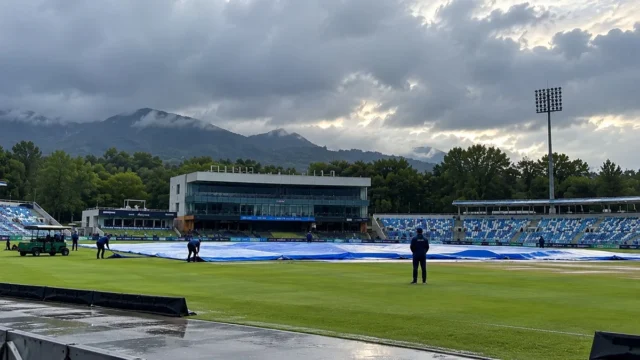
The build-up has already been affected by bad weather, and the latest match-day reports indicate that the toss has been delayed because of a wet outfield. That is a significant development because India have also had limited opportunity to properly assess the surface after weather disrupted their preparation.
For that reason, this is not a day to make an easy prediction that Sano will simply be a batting or bowling wicket. The condition of the outfield, moisture around the surface and how the new ball behaves during the opening overs could matter considerably more.
India vs Japan T20I Match Details
| Detail | Information |
|---|---|
| Match | India vs Japan |
| Format | One-off T20I |
| Trophy | Suzuki Cup 2026 |
| Date | September 22, 2026 |
| Venue | Sano International Cricket Ground |
| Location | Sano, Tochigi Prefecture, Japan |
| Scheduled start | 1:00 PM local time |
| India time | 9:30 AM IST |
| India captain | Shreyas Iyer |
| Japan captain | Kendel Kadowaki-Fleming |
The ICC confirmed Sano International Cricket Ground as the venue for the first international meeting between India and Japan. Both sides are also preparing for the Asian Games, although today’s Suzuki Cup fixture is a separate T20I rather than part of the Asian Games competition.
What Is the Sano International Cricket Ground Pitch Like?
There is an important limitation when analysing this surface: Sano does not have the same volume of elite international data available as major venues in India, Australia or England. Using a small collection of lower-level matches to claim an exact T20I average or a fixed par score could therefore be misleading.
The better approach is to read the conditions that actually exist today. Recent rainfall means there could be moisture around the square, while a damp outfield can make boundary-hitting more difficult even when the pitch itself plays reasonably well.
If the surface retains moisture, seamers may find some movement during the first few overs. As the pitch dries, batting could become more comfortable, although that will depend heavily on whether further showers arrive during the match.
This makes the first two or three overs especially valuable for understanding the Sano International Cricket Ground pitch today. How much the ball carries, whether there is lateral movement and how quickly the outfield allows the ball to travel will tell us considerably more than historical averages alone.
Wet Outfield Is the Biggest Match-Day Factor
The biggest development ahead of the first ball is not necessarily the pitch itself. Reports from Sano indicate that the toss has been delayed because of the wet outfield, following heavy rain in the region.
That follows an already difficult build-up. India’s practice plans were affected by the weather, while the Japan-Hong Kong match scheduled at the same ground on September 20 was abandoned because of rain.
A wet outfield can change a T20 even when the central pitch is considered playable. Fielders may find movement more difficult, the ball can become wet after travelling through damp grass and boundaries may require more power if the outfield is slower than normal.
For India, this also means there is less first-hand information available than the team would ideally want before a match at an unfamiliar venue.
Will Fast Bowlers Get Help at Sano?
The conditions give India’s fast bowlers an interesting opportunity. Jasprit Bumrah and Arshdeep Singh are capable of exploiting even limited new-ball movement, and moisture around the surface could make their opening spells particularly challenging for Japan.
However, it would be premature to describe Sano as a pace-friendly wicket before seeing the ball behave. Rain around a venue does not automatically mean the playing surface will produce dramatic seam movement, particularly if the square has remained adequately covered.
What matters is whether there is enough moisture underneath the surface to create movement or inconsistent pace. If there is, the team bowling first could have a short window in which the new ball becomes particularly valuable.
If the surface instead dries quickly, India may have to rely more on variations and changes of pace as the innings develops.
Could Spin Become Important?
Spin remains relevant despite the focus on rain and seam movement. India have options such as Axar Patel, Washington Sundar, Ravi Bishnoi and Vipraj Nigam in the squad, giving Shreyas Iyer several different ways of attacking the middle overs.
A surface that becomes slightly slower after the new ball loses its hardness could bring those bowlers into the contest. Bishnoi’s quicker leg-spin and Axar’s flatter trajectory, for example, create very different problems for batters attempting to accelerate.
Japan’s ability to rotate strike against spin could therefore be an important part of their innings. Trying to attack every delivery against India’s spinners could create exactly the wicket-taking opportunities India want.
The final bowling combination will obviously depend on the confirmed XI, but the conditions make balance more useful than loading the side exclusively with either pace or spin.
Should the Toss Winner Bat or Bowl First?
Under normal circumstances, historical venue data would play a major role in answering this question. Today’s India vs Japan pitch report, however, has an additional variable: the weather.
With a wet outfield and rain having affected the build-up, bowling first could allow a captain to see exactly how the surface behaves before setting a chase. If further rain is possible, chasing can also simplify calculations in a shortened game because the target can be adjusted.
There is another side to that argument. If the pitch is initially damp and becomes progressively easier for batting, chasing could be advantageous; but if conditions deteriorate again later, batting first while the weather is relatively clear could have value.
The toss decision should therefore be based on the match-day inspection rather than a fixed Sano trend. The captains and team management will have more useful information after walking onto the square than any pre-match statistical model can provide.
What Could Be a Good First-Innings Score?
This is another area where caution is needed. Some preview sites have published specific average scores for Sano, but the ground does not have enough comparable top-level India-style T20I data to treat a single historical average as a reliable benchmark.
The difference in experience between the two batting attacks also makes a simple venue average less useful. A total that Japan consider competitive against India’s attack may be very different from the score India could target if Abhishek Sharma, Sanju Samson, Ishan Kishan, Tilak Varma or Vaibhav Sooryavanshi get significant time at the crease.
If India bat first on a reasonably dry surface, the early run rate will quickly give us a more realistic indication of what is possible. Conversely, if Japan bat first and India find substantial new-ball movement, a much lower-scoring contest could develop.
For TeamStats readers, I would therefore avoid presenting an invented number such as “160 is definitely par.” Today’s conditions simply contain too many variables for that claim to be reliable before the surface is tested.
Vaibhav Sooryavanshi Could Be Interesting on This Surface
Vaibhav Sooryavanshi is one of the most closely watched members of India’s squad, particularly because a match against Japan could provide another opportunity for the young left-hander. His naturally aggressive approach would be particularly interesting if India bat first and the surface proves better than the rain-affected build-up suggests.
A slower outfield, however, could demand a slightly different approach. Shots that normally race to the boundary may hold up, putting greater value on running between the wickets and finding gaps rather than relying entirely on power.
Vaibhav’s development across formats has already created a substantial statistical record. Readers following his performances can find our complete collection of reports, records and updates in the Vaibhav Suryavanshi section on TeamStats.
His inclusion still depends on India’s confirmed XI. Until the toss and teams are officially announced, it is better to treat his appearance as a possibility rather than a certainty.
Bigger Boundaries Could Also Matter
Sano is not necessarily the type of ground where every mistimed aerial shot will automatically clear the rope. Published venue information indicates that some boundary dimensions can extend towards approximately 80 metres, although exact playing dimensions can change depending on the strip and boundary configuration used for a particular match.
That could increase the value of placement and running between the wickets, especially if the outfield remains damp. Bigger boundaries also give spinners and slower-ball bowlers greater confidence to encourage batters to hit towards the longer parts of the ground.
For Japan, boundary dimensions could potentially help their bowlers if they maintain disciplined lengths. For India, the challenge would be recognising quickly which areas of the ground offer the safest scoring options rather than simply attempting to overpower the attack.
How the Conditions Could Affect Japan
Japan face the more difficult adjustment because India’s attack offers significantly greater international experience. If the new ball moves, their top order will have to negotiate Bumrah or Arshdeep before thinking about accelerating.
Preserving wickets through the opening overs could therefore be more valuable than attempting to match India’s expected scoring rate immediately. Once the ball becomes older and conditions become clearer, Japan can reassess how aggressively they want to attack.
Home familiarity is one advantage Japan do possess. Their players have considerably more experience with Japanese cricket conditions than India’s squad, even though today’s rain makes the surface less predictable than usual.
Captain Kendel Kadowaki-Fleming will be particularly important if Japan bat first. A stable innings from an experienced batter could allow the players around him to take calculated risks rather than forcing the entire top order to attack India’s bowlers from the beginning.
How India Could Approach the Conditions
India’s approach should depend heavily on what they observe during the opening phase. If they bowl first and receive new-ball assistance, Shreyas Iyer has enough pace quality to attack rather than immediately switching to defensive fields.
If India bat first, there is little reason to decide on a target before seeing how quickly the outfield is moving. Abhishek Sharma and India’s other attacking options are capable of pushing the scoring rate rapidly, but shot selection becomes more important if the surface is holding up or the boundary areas remain damp.
The match is also India’s final international preparation before their Asian Games campaign begins at the quarterfinal stage. That makes the contest useful not only for the result but for learning how players respond to unfamiliar Japanese conditions. The ICC has described the fixture as an important warm-up ahead of the Asian Games.
India vs Japan Pitch Report: Final Assessment
The India vs Japan pitch report today is less about a simple batting-versus-bowling verdict and more about how Sano International Cricket Ground responds after significant rain. The wet outfield has already affected proceedings, while disrupted practice has limited India’s opportunity to study the venue under normal conditions.
If moisture remains in the surface, fast bowlers could be particularly important during the opening overs. If the pitch dries and remains firm, India’s batting depth could turn the match into a much higher-scoring contest. Spin may become more relevant once the ball gets older, especially if the surface slows during the middle overs.
The toss will matter, but the captains should base their decision on the actual match-day inspection rather than a generic venue trend. With rain having affected the build-up and the toss already delayed by the wet outfield, conditions immediately before the first ball are the most important part of today’s Sano pitch assessment.

Related Posts
India vs Afghanistan Pitch Report: Will Delhi Produce Another High-Scoring T20I?
India vs Afghanistan Pitch Report Today: Will Korogi Sports Park Help Spinners in Asian Games Quarter-Final?
IND vs WI Pitch Report Today: India vs West Indies Pitch, Weather & Venue Records

India vs Japan T20I Today: Match Time, Playing XI, Weather, Squads & Latest Updates
India Women vs Sri Lanka Women Pitch Report Today: Korogi Sports Park Pitch for Asian Games 2026 Final