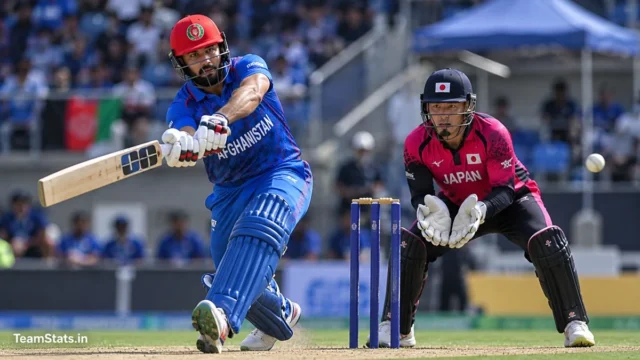
Abhishek Sharma Stats: T20I Runs, Centuries, Strike Rate & Records After 30-Ball Hundred
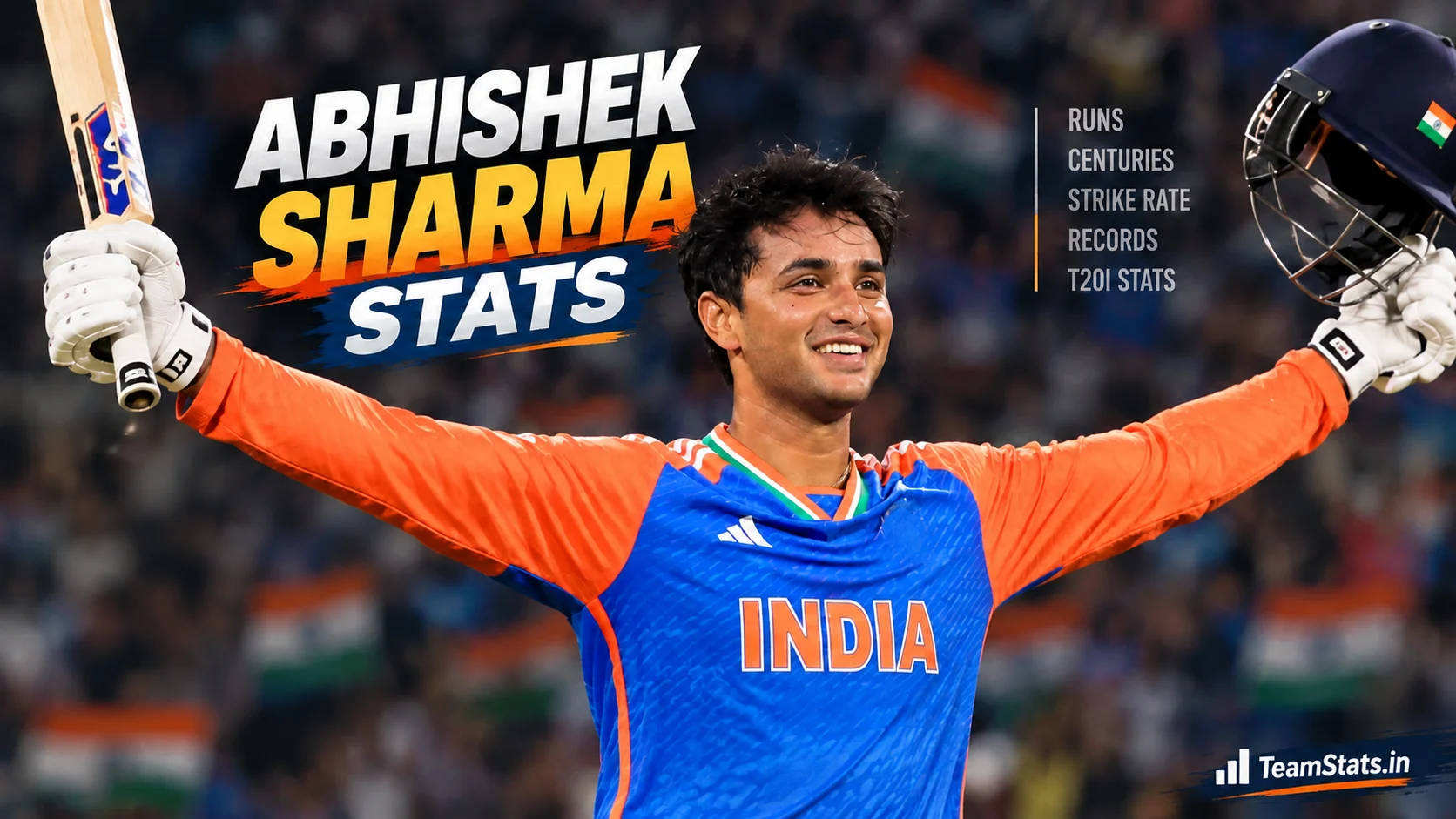
Abhishek Sharma Stats: T20I Runs, Centuries, Strike Rate & Records After Historic 30-Ball Hundred
Abhishek Sharma has turned explosive batting into record-breaking batting.
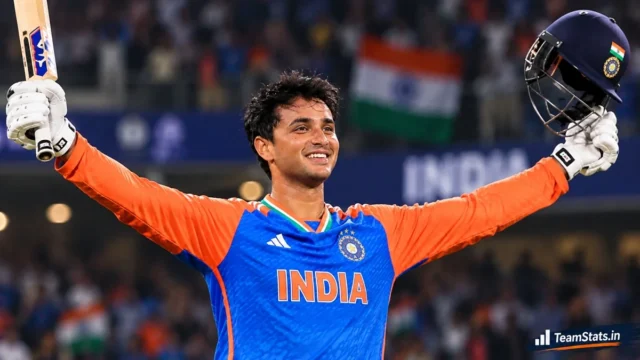
The Indian left-hander produced one of the most destructive innings in men’s T20I cricket against Afghanistan in Delhi, smashing 108 from only 34 balls in the third T20I on September 17, 2026.
The headline number was even more remarkable: Abhishek reached his century in only 30 balls, breaking Rohit Sharma’s record for the fastest T20I hundred by an Indian. Rohit had reached the landmark from 35 deliveries against Sri Lanka in 2017.
But the century is only part of the story behind the latest Abhishek Sharma stats.
He scored heavily throughout the three-match Afghanistan series, moved up the ICC T20I batting rankings and strengthened his position as one of India’s most dangerous Powerplay batters.
India eventually completed a 3-0 series sweep, with Abhishek’s century powering the team to a 127-run victory in the finale.
For the complete results and series coverage, see our Afghanistan vs India T20I Series 2026 page.
Abhishek Sharma Stats vs Afghanistan 2026
Abhishek was India’s most destructive batter across the three T20Is.
His scores tell the story:
| Match | Runs | Balls | Key performance |
|---|---|---|---|
| 1st T20I | 82 | 32 | Explosive series opener |
| 2nd T20I | 39 | 19 | Helped India dominate the chase |
| 3rd T20I | 108 | 34 | Record 30-ball century |
| Series total | 229 | 85 | One century + one fifty |
That works out to a remarkable series strike rate of approximately 269.41.
Abhishek scored 229 runs from only 85 deliveries across the three matches.
What makes those numbers particularly impressive is that he did not rely entirely on the century.
He started the series with 82 from 32 balls, followed it with 39 from 19, and then produced his record-breaking 108.
His lowest score of the series was therefore 39.
Readers comparing India’s batting performances can also see our Sanju Samson Stats vs Afghanistan analysis. Samson also finished the series strongly with back-to-back half-centuries.
Abhishek Sharma’s 108 off 34 Balls: Complete Breakdown
The third T20I produced the defining innings of Abhishek’s series.
Here are the key numbers:
| Stat | Abhishek Sharma |
|---|---|
| Runs | 108 |
| Balls | 34 |
| Strike rate | 317.64 |
| Fours | 9 |
| Sixes | 11 |
| Balls to fifty | 16 |
| Balls to hundred | 30 |
| Powerplay runs | 76 off 22 |
| Opening partnership | 142 with Sanju Samson |
| India total | 221/7 |
| Result | India won by 127 runs |
The innings was extraordinary even by modern T20 standards.
Abhishek reached his fifty from 16 balls and then needed only another 14 deliveries to move from 50 to 100.
By the time he was dismissed by Rashid Khan, he had made 108 from 34 deliveries, including nine fours and 11 sixes.
His final strike rate was 317.64.
Fastest T20I Century by an Indian
The biggest record from the innings was the speed of Abhishek’s century.
He reached 100 in 30 balls.
That moved him past Rohit Sharma for the fastest T20I century by an Indian men’s batter.
| Player | Balls to 100 | Opposition |
|---|---|---|
| Abhishek Sharma | 30 | Afghanistan |
| Rohit Sharma | 35 | Sri Lanka |
| Abhishek Sharma | 37 | England |
Abhishek’s previous 37-ball century had come against England at the Wankhede Stadium in 2025.
That means he now owns two T20I hundreds completed in fewer than 40 balls.
It also shows why his career numbers cannot be evaluated using runs and average alone.
Few international batters can change a match as rapidly as Abhishek when he survives the opening phase.
Where Does the 30-Ball Hundred Rank in T20I History?
Abhishek’s century was not only an Indian record.
It was also among the fastest hundreds ever recorded in men’s T20Is.
The overall record remains Sahil Chauhan’s 27-ball century for Estonia against Cyprus, while Muhammad Fahad reached a hundred from 29 balls for Turkey against Bulgaria.
Abhishek’s 30-ball effort therefore sits immediately behind those performances and was the fastest T20I hundred against a Full Member/Test-playing nation.
That distinction is important when putting the innings into context.
Afghanistan’s attack included experienced international bowlers such as Rashid Khan, Mohammad Nabi, Mujeeb Ur Rahman and Fazalhaq Farooqi.
Abhishek attacked virtually every phase of the innings.
76 Runs in the Powerplay: Another Record Falls
The century understandably received most of the attention, but one of the most extraordinary Abhishek Sharma stats from the innings came before the Powerplay had even ended.
He scored 76 runs from only 22 balls during the first six overs.
That became the highest individual Powerplay score in men’s T20I cricket.
Abhishek also hit aggressively against both pace and spin rather than waiting for a particular bowling matchup.
India’s Powerplay became so dominant that Afghanistan were effectively trying to recover from the opening assault for the remainder of the innings.
It also reinforced a pattern that has become central to Abhishek’s international career: he does not treat the first six overs as a period for settling in.
He treats them as a scoring opportunity.
Abhishek Sharma and Sanju Samson Put on 142
The third T20I was not a one-man innings.
Sanju Samson provided valuable support at the other end.
The pair added 142 runs for the opening wicket, with Samson eventually making 50 from 35 balls.
Their roles were clearly defined.
Abhishek attacked relentlessly while Samson provided another substantial contribution after his 57 off 22 in the previous match.
By the time Afghanistan finally removed Abhishek, India had already built the foundation for a huge total.
The partnership also followed an 88-run opening stand between the pair in the second T20I.
For a detailed look at Samson’s turnaround during the series, read our Sanju Samson Stats vs Afghanistan: Complete Series Analysis.
Abhishek Sharma’s Afghanistan Series Was More Than One Century
The 108 will naturally dominate discussion of the series, but focusing exclusively on the final match would undersell Abhishek’s performance.
His three scores were:
82 → 39 → 108
That is remarkable consistency considering the speed at which he was scoring.
He accumulated 229 runs while facing only 85 balls.
Even his lowest score, 39, came from only 19 deliveries.
That is exactly why strike rate needs to sit alongside total runs when analysing Abhishek.
Traditional batting analysis often asks how long a batter remained at the crease.
With Abhishek, a more relevant question is how much damage he caused while he was there.
Against Afghanistan, the answer was considerable.
Six-Hitting Is Becoming a Defining Abhishek Sharma Stat
Another number from the third T20I illustrates his approach.
11 sixes.
He hit more sixes than fours during his 108, clearing the boundary 11 times while hitting nine fours.
The frequency of those sixes matters because it dramatically increases the scoring ceiling of an innings.
A batter who relies primarily on fours still needs regular boundary opportunities.
Six-hitting allows Abhishek to turn a good over into a 20-run over extremely quickly.
His Powerplay numbers reinforce the same point.
By the Afghanistan finale, Abhishek had struck 37 Powerplay sixes in T20Is during 2026, surpassing his own 2025 mark of 34.
That is not simply aggressive batting.
It is sustained boundary production at the start of international innings.
Abhishek Sharma’s Fastest T20I Fifties
The Afghanistan century also produced another extremely quick half-century.
Abhishek reached 50 from 16 balls.
Remarkably, that was not even his fastest international fifty.
Earlier in 2026, he had reached a T20I fifty from 14 balls against New Zealand in Guwahati.
Only Yuvraj Singh’s famous 12-ball fifty against England in the 2007 T20 World Cup remains faster among Indian men’s T20I performances.
Abhishek has now recorded multiple international fifties at a pace that would once have been considered exceptional even in franchise cricket.
That ability is central to his value.
He can potentially decide the direction of a T20 match before the Powerplay ends.
ICC T20I Ranking: Abhishek Sharma Climbs to No. 2
His performances were also reflected in the ICC rankings.
In the rankings update released before the third T20I, Abhishek climbed to No. 2 among men’s T20I batters, moving ahead of Pakistan opener Sahibzada Farhan.
He reached 862 rating points, with fellow India batter Ishan Kishan occupying the No. 1 position at that update.
Importantly, that ranking update did not yet include the 108 off 34 in the third T20I.
That distinction should be kept in mind when reading the latest ranking number.
The next rankings update will show how the record century affects his rating.
Why Abhishek’s Strike Rate Matters More Than a Conventional Average
There is a broader reason Abhishek Sharma’s statistics are interesting.
T20 batting is increasingly moving away from evaluating openers primarily by average.
Consider two hypothetical innings:
60 off 50 balls
and
45 off 18 balls
The first produces more runs.
The second may create substantially more match value depending on conditions and the target.
Abhishek’s batting is built around the second principle.
His Afghanistan series demonstrated it perfectly.
Even his 39 in the second match came at better than two runs per ball.
Then his 108 arrived at a strike rate above 317.
The risk is obvious: such an approach can produce low scores.
The reward is equally obvious: when it succeeds, India can effectively take control of a T20 match within a handful of overs.
Abhishek Sharma Has Three T20I Centuries
The Afghanistan hundred was the third T20I century of Abhishek Sharma’s career.
That is significant because international T20 hundreds remain relatively rare, particularly for players whose primary objective is maximising the Powerplay rather than batting conservatively deep into an innings.
His ability to convert explosive starts into hundreds separates him from batters who regularly produce 30s and 40s at high strike rates but rarely continue.
And the speed of those hundreds makes the record even more unusual.
Two have now been completed inside 40 deliveries.
From Lean Run to 229 Runs Against Afghanistan
Perhaps the most useful context surrounding Abhishek’s Afghanistan performance is what happened immediately beforehand.
He entered the series without a fifty in his previous seven T20I innings.
There were four single-digit scores during that stretch.
Then came:
82 off 32
39 off 19
108 off 34
That turnaround illustrates the volatility that comes with an ultra-aggressive opener.
Short-term form can look poor because dismissals are an unavoidable consequence of consistently attacking.
But when that method works across several consecutive matches, the numbers can change extraordinarily quickly.
Against Afghanistan, Abhishek moved from a seven-innings run without a fifty to finishing a three-match series with 229 runs and a record-breaking century.
What Abhishek Sharma’s Stats Mean for India’s Top Order
India now have significant competition for top-order positions.
Sanju Samson finished the Afghanistan series with consecutive fifties.
Ishan Kishan remains another major option.
Vaibhav Sooryavanshi is among India’s most exciting young attacking batters.
Yet Abhishek’s Afghanistan series made one part of the selection equation straightforward: dropping a batter producing this level of Powerplay impact would be extremely difficult.
Readers can follow individual Indian player records through our Players Stats hub.
The competition should also be viewed positively from India’s perspective.
Different combinations can be used depending on conditions, opposition and tournament requirements.
Abhishek’s specific value is clear: he offers the possibility of transforming a match before the opposition has settled.
Asian Games 2026 Comes Next
The Afghanistan series is over, but India’s T20 calendar continues immediately.
India now turn their attention towards the Asian Games 2026 in Japan, where Abhishek is part of another powerful Indian batting group.
That makes his current form particularly relevant.
Rather than entering the tournament simply as an aggressive opener, he arrives after producing one of the fastest centuries in international cricket.
Follow our Asian Games Cricket 2026 coverage for the tournament schedule, squads, fixtures and latest updates.
Abhishek Sharma Stats: The Numbers That Stand Out
After the Afghanistan series, several numbers define Abhishek’s current T20I profile:
30 balls — fastest T20I hundred by an Indian.
108 off 34 — his score in the third T20I against Afghanistan.
317.64 — strike rate in that innings.
16 balls — time taken to reach fifty.
76 off 22 — runs scored during the Powerplay.
11 sixes — sixes in his 108.
229 runs — total in the three-match Afghanistan series.
269.41 — approximate strike rate across that series.
3 — T20I centuries in his career after the Afghanistan hundred.
No. 2 — position in the ICC men’s T20I batting rankings released before the series finale.
Together, those numbers explain why Abhishek has become such an important part of India’s T20 batting setup.
Abhishek Sharma Stats: Final Takeaway
Abhishek Sharma’s 2026 Afghanistan series was not simply another productive bilateral series.
It contained an innings that changed the record books.
His 108 from 34 balls included a 30-ball century, breaking Rohit Sharma’s Indian T20I record and becoming the fastest hundred against a Full Member nation.
But the complete series deserves equal attention.
Abhishek scored 82, 39 and 108, accumulating 229 runs from just 85 balls.
He attacked pace.
He attacked spin.
He dominated the Powerplay.
And when he reached the series finale, he turned an explosive start into his third international T20 century.
The next challenge is sustaining that level of impact as opposition teams continue developing plans specifically for him.
For now, however, the latest Abhishek Sharma stats show an opener operating at an extraordinary scoring rate.
For more individual records, visit our Cricket Players Stats section. You can also track the complete series through Afghanistan vs India T20I Series 2026 and compare the rivalry through our India vs Afghanistan Head-to-Head T20I Record.
Official sources for statistical verification: ICC official cricket website and BCCI official website.

Related Posts
Rachin Ravindra Stats: Runs, Centuries, Wickets, Test, ODI, T20I & IPL Records
Virat Kohli Stats: Runs, Centuries, Records, ODI, Test, T20I & IPL

Rohit Sharma Stats – Runs, Centuries & Records
Shubman Gill Stats: Career Runs, Centuries, 208, IPL Records & 2026 Form
Abhishek Sharma Smashes 30-Ball Century as Records Tumble in Delhi