
Sanju Samson Stats vs Afghanistan: 117 Runs, Back-to-Back Fifties in 3-0 Sweep
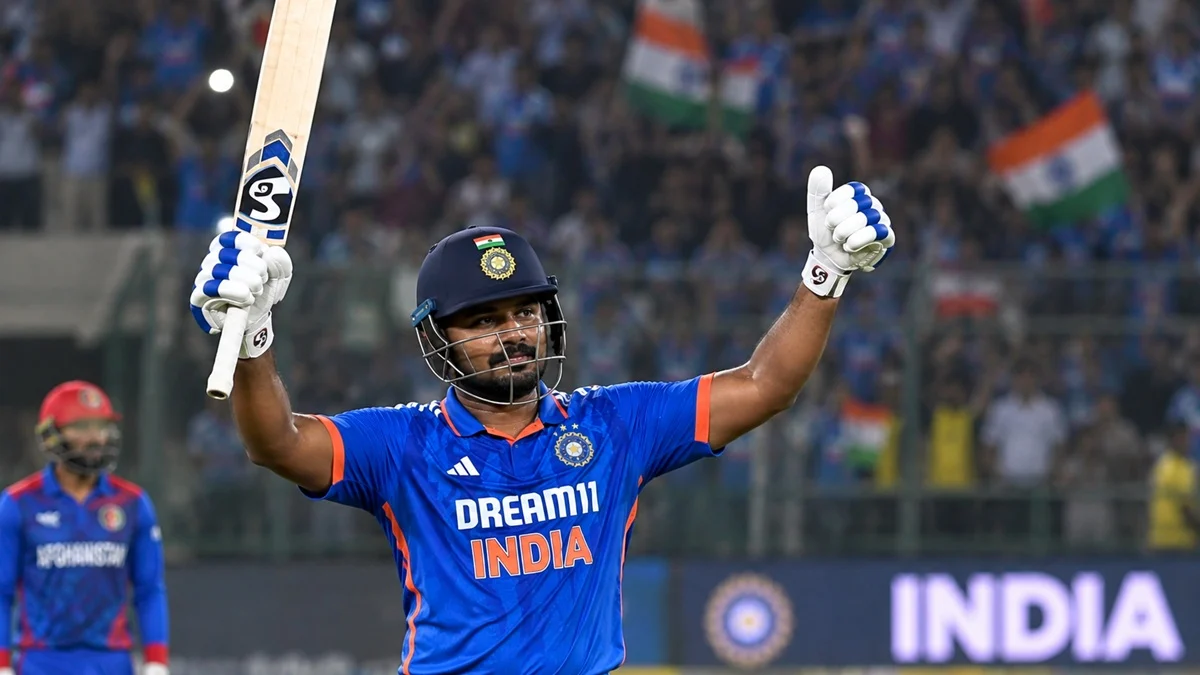
Sanju Samson Stats vs Afghanistan: 117 Runs as India Complete 3-0 T20I Sweep
Sanju Samson finished the Afghanistan T20I series with 117 runs and back-to-back half-centuries, turning a quiet start into an encouraging finish as India completed a 3-0 series sweep.
Samson began the series with only 10 runs, but his response was emphatic. He smashed 57 from just 22 balls in the second T20I before following it with 50 from 35 balls in the third match.
The sequence — 10, 57 and 50 — tells the story of his series.
His second-match innings was the more explosive of the two fifties, but the final T20I provided further evidence that the turnaround was not limited to one innings.
India ultimately completed the series without a defeat, while Samson finished with two consecutive scores of 50 or more.
For the complete series picture, including fixtures, squads and results, readers can follow our Afghanistan vs India T20I Series 2026 coverage.
Sanju Samson Stats vs Afghanistan in 2026 T20I Series
Here is how Samson performed across the three matches:
| Match | Runs | Balls | Key takeaway |
|---|---|---|---|
| 1st T20I | 10 | — | Quiet start |
| 2nd T20I | 57 | 22 | 20-ball fifty |
| 3rd T20I | 50 | 35 | Second successive fifty |
| Series total | 117 | — | Two consecutive fifties |
The progression is more important than simply looking at the total.
After making only 10 in the opening game, Samson could easily have entered the second T20I with a more conservative approach.
Instead, he went in the opposite direction.
He attacked Afghanistan immediately and reached his half-century in only 20 deliveries. That innings helped transform both India’s chase and the conversation surrounding his form.
He then backed it up with another fifty in the series finale.
Abhishek Sharma Stats: T20I Runs, Centuries, Strike Rate & Records
From 10 Runs to Back-to-Back Fifties
Samson’s series can effectively be divided into two parts.
The first was another low score.
The second was his response.
Before his 57 in the second T20I, Samson had gone through a sequence of relatively modest international scores. That made the Afghanistan series particularly relevant because India have considerable competition for batting positions.
But Samson did not attempt to protect his place by batting cautiously.
His 57 off 22 balls came at a strike rate of 259.09 and included seven fours and four sixes.
He reached fifty in only 20 balls.
India’s opening pair of Samson and Abhishek Sharma added 88 runs in 6.2 overs, with India racing to 82/0 at the end of the Powerplay.
By the time Samson was dismissed, the chase had already been put firmly under India’s control.
India eventually reached 163/3 in 14.5 overs, winning the second T20I by seven wickets and securing the series with one match remaining.
That performance alone ended Samson’s lean sequence.
The third T20I then turned the comeback into a pattern.
Samson Scores 50 in the Final T20I
The final match gave Samson another opportunity at the top of the order, and this time he produced 50 from 35 balls.
It was very different from his 22-ball assault in the previous game.
That difference is useful when assessing his series.
Samson did not need to reproduce a strike rate above 250 to make another meaningful contribution. Instead, he supported an extraordinary innings from Abhishek Sharma as India’s opening pair built a huge platform.
Samson and Abhishek added 142 runs for the opening wicket.
Abhishek dominated the partnership, smashing 108 from only 34 balls and reaching his century in 30 deliveries.
Samson’s role was less spectacular but still significant: another fifty meant he had followed his 10 in the opener with consecutive half-centuries.
India went on to score 221/7.
Afghanistan were then bowled out for 94, giving India a 127-run victory and completing the 3-0 sweep.
Readers looking at the broader rivalry can also check our India vs Afghanistan Head-to-Head T20I Record, which tracks the results and numbers behind the two teams’ meetings.
Sanju Samson’s 57 off 22 Was the Turning Point
Although Samson finished the series with another fifty, the second T20I remains the innings that changed his series.
Here are the numbers from that knock:
| Stat | Sanju Samson |
|---|---|
| Runs | 57 |
| Balls | 22 |
| Strike rate | 259.09 |
| Balls to fifty | 20 |
| Fours | 7 |
| Sixes | 4 |
| Opening partnership | 88 with Abhishek Sharma |
| India Powerplay | 82/0 |
| Match result | India won by 7 wickets |
The strike rate of 259.09 only tells part of the story.
Afghanistan had made 159/8, which could have created some pressure if India lost early wickets.
Instead, Samson and Abhishek effectively removed that possibility inside the Powerplay.
Samson was the primary aggressor in the partnership, while Abhishek contributed 39 from 19 balls.
It was exactly the type of high-impact innings India have increasingly encouraged from their T20 top order.
Why the Two Fifties Matter for Samson
The timing of the performances is important.
Before the second T20I, Samson’s previous five international innings had produced scores of:
5, 0, 1, 27 and 10.
That was 43 runs across five innings, an average of 8.6.
The sequence inevitably created discussion around his form, particularly because India’s batting depth means there is competition for virtually every top-order position.
Samson’s response was not to abandon his aggressive method.
He attacked.
The result was a 20-ball fifty followed by another half-century in the final match.
Across the final two T20Is against Afghanistan, Samson therefore scored:
107 runs from 57 balls.
That represents a combined strike rate of approximately 187.72.
This is arguably a more useful way of assessing the turnaround than simply looking at his 117 series runs.
The first match was a failure.
The next two were substantial contributions.
Samson and Abhishek Sharma Form a Dangerous Opening Combination
Another major takeaway from the series was Samson’s partnership with Abhishek Sharma.
In the second T20I, they added 88 in 6.2 overs.
In the third, the partnership grew to 142 runs.
The two innings were not identical, however.
Samson dominated much of the second-match Powerplay, while Abhishek produced the defining innings of the final T20I.
That flexibility matters.
An aggressive opening partnership does not require the same batter to dominate every match. When one opener attacks at an exceptional rate, the other can still maintain pressure without forcing every delivery.
India saw both versions during this series.
For readers tracking how India’s combinations developed across the three games, our India vs Afghanistan Playing XI page provides additional selection context.
The Bigger Context: Samson’s T20 World Cup 2026
The Afghanistan series should also be viewed alongside Samson’s performances earlier in 2026.
His short run of low scores before the second T20I looked concerning in isolation.
The wider picture was very different.
Samson finished the ICC Men’s T20 World Cup 2026 with 321 runs from five innings, averaging 80.25 while striking at 199.37.
Three performances were particularly important:
| Stage | Samson’s score |
|---|---|
| Super Eight vs West Indies | 97* |
| Semi-final vs England | 89 |
| Final vs New Zealand | 89 |
He was subsequently named Player of the Tournament as India successfully defended the T20 World Cup title.
That context changes how the Afghanistan series should be interpreted.
The 57 off 22 was not evidence of Samson suddenly discovering an attacking method.
It was a return to the approach that had already produced major results for him on the biggest stage.
And by following it with another fifty, Samson reduced the possibility of the second-match innings being dismissed as an isolated performance.
Sanju Samson vs Afghanistan: Series Progression
The simplest way to understand Samson’s series is through the progression of his scores:
10 → 57 → 50
There are several notable points within those three numbers.
He increased his score by 47 runs between the first and second matches.
He reached fifty in only 20 balls in the second game.
He then registered another half-century in the third match.
Most importantly, Samson did not allow one low score to change his natural batting method.
For an opener operating in India’s current T20 setup, that may be as relevant as the aggregate itself.
India’s approach demands early scoring and pressure on the opposition during the Powerplay. Samson demonstrated that ability particularly clearly in the second T20I.
What Happened With Vaibhav Sooryavanshi?
Vaibhav Sooryavanshi was one of the most interesting selection stories surrounding the series.
India included the teenage batter in the Afghanistan squad, creating considerable interest around a possible international opportunity.
However, Sooryavanshi did not make the Playing XI during the three-match series.
India instead continued with their existing combinations and completed the series 3-0.
That means the Afghanistan series should not be viewed as a direct Samson-versus-Sooryavanshi selection contest.
Samson produced two consecutive fifties, while Sooryavanshi’s opportunity will have to come at another stage.
The teenager remains an important player to watch, particularly with India’s Asian Games 2026 campaign approaching.
Our Asian Games Cricket 2026 hub tracks the schedule, teams, squads and tournament updates.
Samson Remains Important to India’s Asian Games Plans
The end of the Afghanistan series does not end the selection discussion.
Samson has also been included as a wicketkeeping option in India’s Asian Games squad alongside Ishan Kishan.
That squad contains several aggressive batting options, including Abhishek Sharma and Vaibhav Sooryavanshi.
Samson therefore enters the next phase of India’s T20 calendar in a considerably stronger position than he appeared to be in after the opening Afghanistan match.
Two innings cannot guarantee a place in a competitive Indian batting order.
But two successive fifties are meaningful evidence of form.
More importantly, one of those innings came at a strike rate above 250.
That combination of consistency and impact is exactly what makes Samson an interesting option in India’s T20 setup.
What the Afghanistan Series Actually Tells Us About Samson
There is a temptation in T20 cricket to draw sweeping conclusions from very small samples.
Samson’s series is a good example of why that can be misleading.
After the first match, his recent sequence looked poor.
After three matches, the picture looks substantially different.
He finishes with:
117 total runs
Two consecutive half-centuries
57 off 22 in the second T20I
50 off 35 in the third T20I
A 20-ball fifty
An 88-run opening partnership in the second match
A 142-run opening partnership in the third match
Those numbers do not erase the low scores that preceded them.
They do, however, demonstrate how quickly an aggressive T20 opener can change his statistical picture.
Samson went from 10 in the opening match to producing 107 runs across his final two innings.
That is the most important statistical story of his Afghanistan series.
Sanju Samson Stats vs Afghanistan: Final Series Takeaway
Sanju Samson’s Afghanistan series began quietly and ended with considerably more substance.
A score of 10 in the opening T20I extended his lean run.
Then came 57 from 22 balls.
Then 50 from 35.
By the end of the three matches, Samson had accumulated 117 runs, registered back-to-back fifties and contributed to two major opening partnerships with Abhishek Sharma.
India, meanwhile, converted their 2-0 advantage into a 3-0 clean sweep, finishing the series with a dominant 127-run victory.
For Samson, the biggest positive was not simply the number of runs.
It was the manner in which they arrived.
He responded to a difficult sequence without abandoning the aggressive batting style that has produced some of his best T20 performances.
With India’s attention now shifting toward upcoming assignments, Samson leaves the Afghanistan series with momentum restored and another strong set of numbers added to his 2026 record.

Related Posts
Shubman Gill Stats: Career Runs, Centuries, 208, IPL Records & 2026 Form
Abhishek Sharma Stats: T20I Runs, Centuries, Strike Rate & Records After 30-Ball Hundred
Afghanistan National Cricket Team vs Japan National Cricket Team Stats & Records
Afghanistan vs Japan Asian Games 2026: Arab Gul Takes 4/8 as Afghanistan Win by 48 Runs
Rachin Ravindra Stats: Runs, Centuries, Wickets, Test, ODI, T20I & IPL Records