East Zone Cricket Team vs South Zone Cricket Team Stats: From 708 to a 584-Run Lead – The Numbers Behind East Zone’s Dominance
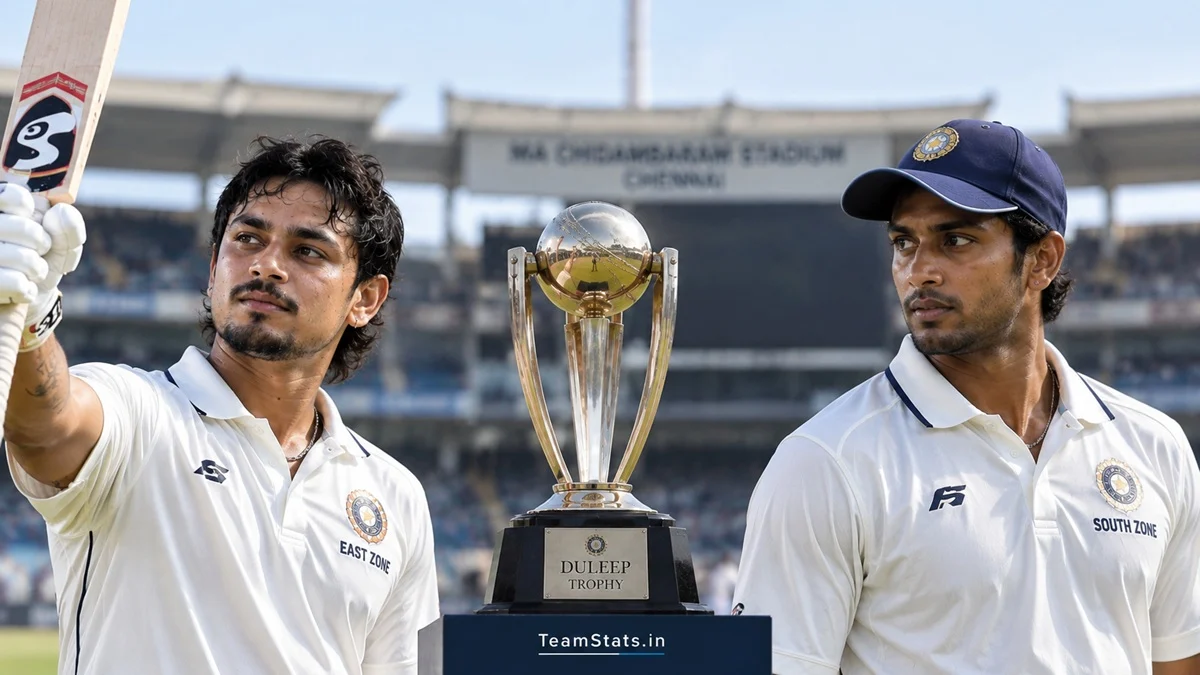
East Zone vs South Zone Stats: Ishan Kishan’s 350 Runs Put East Zone on Brink of Duleep Trophy Glory
The East Zone cricket team vs South Zone cricket team stats have become one of the biggest talking points in Indian domestic cricket after four remarkable days of the 2026 Duleep Trophy final in Chennai.
East Zone captain Ishan Kishan produced an extraordinary 270 from 334 balls in the first innings, while Kumar Kushagra added 101 as East Zone piled up a massive 708 all out at the MA Chidambaram Stadium.
But the story did not stop there.
South Zone responded with 336 all out, despite captain Tilak Varma fighting his way to 99. That handed East Zone a huge 372-run first-innings lead.
Kishan then returned in the second innings and struck another 80, taking his match aggregate to an astonishing 350 runs.
At stumps on Day 4, East Zone were 212/5, giving them an overall lead of 584 runs heading into the final day.
The numbers are staggering.
But East Zone vs South Zone is bigger than one innings or one final.
The two zonal teams represent some of India’s richest domestic cricket regions and have produced generations of international players. South Zone historically have the stronger Duleep Trophy pedigree, while East Zone have had fewer title-winning campaigns.
The 2026 final, however, has created an opportunity for East Zone to alter that story.
Here is a detailed look at the East Zone cricket team vs South Zone cricket team stats, latest match numbers, Duleep Trophy records, current players and what makes this contest interesting.
East Zone vs South Zone Stats – Quick Overview
| Category | East Zone | South Zone |
|---|---|---|
| Competition | Duleep Trophy | Duleep Trophy |
| 2026 Captain | Ishan Kishan | Tilak Varma |
| 2026 Final | Qualified | Qualified |
| 2026 Semi-final | Beat Central Zone | Beat North Zone |
| Semi-final Margin | 4 wickets | 7 wickets |
| Final Venue | Chennai | Chennai |
| Toss | Won, chose to bat | Lost |
| First Innings | 708 all out | 336 all out |
| First-Innings Difference | Lead by 372 | Trailed by 372 |
| Second Innings | 212/5 at Day 4 stumps | Yet to bat |
| Overall Lead | 584 runs | — |
| Standout Batter | Ishan Kishan – 270 & 80 | Tilak Varma – 99 |
Match status updated through stumps on Day 4.
East Zone vs South Zone Duleep Trophy 2026 Final – Latest Situation
The latest meeting between East Zone and South Zone began on September 6, 2026, at the MA Chidambaram Stadium in Chennai.
East Zone won the toss.
Ishan Kishan chose to bat.
Four days later, that decision looks even more significant than it did after East Zone’s enormous first innings.
East Zone scored:
708 all out in 163 overs
South Zone replied with:
336 all out in 107.3 overs
That gave East Zone a 372-run first-innings advantage.
Instead of enforcing the follow-on, East Zone batted again and reached 212/5 in 51 overs by stumps on Day 4.
The overall advantage:
584 runs
That is the number that now defines the final.
East Zone have not merely built a lead. They have created a match situation in which South Zone face an extraordinary challenge on the final day.
East Zone First Innings Scorecard
| Batter | Runs | Balls |
|---|---|---|
| Abhimanyu Easwaran | 72 | 86 |
| Vaibhav Sooryavanshi | 44 | 37 |
| Shikhar Mohan | 85 | 120 |
| Sudip Kumar Gharami | 6 | 25 |
| Ishan Kishan | 270 | 334 |
| Kumar Kushagra | 101 | 132 |
| Anukul Roy | 45 | 98 |
| Md Kounain Quraishi | 40 | 91 |
| Mohammed Shami | 28 | 51 |
| Abhijit Sarkar | 0* | 6 |
| Mukesh Kumar | 0 | 4 |
The first major statistical takeaway remains remarkable:
East Zone had multiple major contributions throughout the order, with Kishan and Kushagra converting their starts into hundreds.
That batting depth ultimately became even more important once South Zone began their reply.
Ishan Kishan’s 270 Changes the East Zone vs South Zone Numbers
The headline statistic is impossible to miss:
Ishan Kishan – 270 from 334 balls
Kishan’s innings included:
30 fours
7 sixes
334 balls
80.84 strike rate
And most importantly:
270 runs
He temporarily retired hurt with cramps after reaching 250 but returned and extended his innings to 270 before Tripurana Vijay finally dismissed him.
This was not simply a quick double century produced on a batting-friendly surface.
Kishan had to occupy the crease for a long period, deal with Chennai’s conditions and repeatedly rebuild his tempo.
The result was one of the defining innings of the 2026 Duleep Trophy.
How Kishan Built His 270
The progression of the innings tells its own story.
Kishan ended Day 1 unbeaten on 111.
He returned on Day 2 alongside Kumar Kushagra and continued to wear down South Zone.
He reached his first Duleep Trophy double century before eventually moving past 250.
Cramps then forced him to retire hurt.
At that point, it would have been easy to assume his innings was finished.
It wasn’t.
Kishan returned and added another 20 runs before Tripurana Vijay eventually dismissed him for 270.
His final boundary count was remarkable:
37 boundaries — 30 fours and seven sixes.
Those boundaries alone accounted for 162 of his 270 runs.
The remaining 108 came without boundaries.
That balance is particularly relevant when assessing the innings as a red-ball performance rather than simply another example of Kishan’s power hitting.
Kishan Falls Just Three Runs Short of His Career Best
One of the most interesting numbers from the innings is:
3
Kishan’s first-class career-best remains 273.
Against South Zone, he reached 270.
That means he finished only three runs short of equalling his highest first-class score.
Given the importance of the match, however, the 270 may rank among the most significant innings of his domestic career.
And by the end of Day 4, that was no longer his only major contribution.
Ishan Kishan Does It Again – 80 in the Second Innings
This is the biggest statistical update since the original version of this article was published.
After making 270 in the first innings, Kishan returned to score:
80 runs in the second innings
That gave him a match aggregate of:
350 runs
Kishan therefore contributed enormously in both innings of a Duleep Trophy final.
His second innings was particularly valuable because East Zone had slipped to 13/2 early.
South Zone finally found the kind of early bowling success they had been missing in the first innings, but Kishan prevented that opening from developing into a major collapse.
He rebuilt the innings and once again pushed East Zone into a commanding position.
Shikhar Mohan also contributed 52, while East Zone eventually closed Day 4 on 212/5.
The first innings gave East Zone control.
Kishan’s second innings helped make that control overwhelming.
Kishan and Kushagra’s 230-Run Partnership
If 270 is the biggest individual number from the first innings, 230 may be the most important partnership number.
East Zone were 241/4 when Kumar Kushagra joined Kishan.
South Zone had an opening.
Another quick wicket could have changed the complexion of the innings.
Instead:
241/4 became 471/5.
Kishan and Kushagra added 230 runs for the fifth wicket.
Kushagra was far more than a supporting actor.
He made:
101 runs
132 balls
8 fours
5 sixes
Strike rate: 76.52
That partnership effectively removed South Zone’s best opportunity to take control of East Zone’s first innings.
Vaibhav Sooryavanshi Brings Aggression to the Final
One of the most interesting players in the current East Zone side is Vaibhav Sooryavanshi.
He did not make a century.
He did not even reach fifty.
Yet his 44 from 37 balls mattered.
Sooryavanshi struck five fours and a six at a strike rate above 118.
Alongside Abhimanyu Easwaran, he helped East Zone reach 100 for the first wicket.
That changed the tone of the innings immediately.
Instead of spending the opening session merely surviving South Zone’s attack, East Zone forced the bowlers to respond.
Abhimanyu Easwaran Provides Experience
At the opposite end, Abhimanyu Easwaran played a more controlled innings.
He made:
72 from 86 balls
10 fours
1 six
His partnership with Sooryavanshi combined aggression with experience.
Easwaran was eventually run out, but East Zone had already moved comfortably beyond 100.
Shikhar Mohan’s Contribution Should Not Be Overlooked
With Kishan scoring 270 and Kushagra reaching 101, Shikhar Mohan’s contribution can easily disappear from the headline.
It shouldn’t.
Mohan scored 85 from 120 balls in the first innings, including nine fours and three sixes.
He then returned in East Zone’s second innings and made another 52.
That gives his performance greater significance when looking at the entire match rather than only East Zone’s 708.
East Zone’s Lower Order Adds Valuable Runs
Another important statistic appears when looking below the specialist batters.
After Kushagra departed at 471/5, East Zone still found plenty of runs.
Anukul Roy – 45
Kounain Quraishi – 40
Mohammed Shami – 28
Together, those three contributed 113 runs.
Those are the runs that can turn a very good first-innings total into an intimidating one.
East Zone eventually reached 708.
South Zone Bowling Stats
South Zone’s bowlers had a punishing first innings.
| Bowler | Overs | Runs | Wickets | Economy |
|---|---|---|---|---|
| Mohammed Siraj | 25 | 140 | 0 | 5.60 |
| MD Nidheesh | 15 | 58 | 0 | 3.86 |
| Tripurana Vijay | 42 | 180 | 4 | 4.28 |
| Chama Milind | 21 | 88 | 2 | 4.19 |
| Shreyas Gopal | 42 | 165 | 2 | 3.92 |
The standout wicket-taker for South Zone was Tripurana Vijay.
He took four wickets, including the biggest one:
Ishan Kishan – 270.
But even Vijay’s success came at a significant cost—180 runs across 42 overs.
Mohammed Siraj’s Two Very Different Innings
Perhaps the most surprising South Zone statistic from East Zone’s first innings belonged to Mohammed Siraj.
25 overs
140 runs
0 wickets
Economy: 5.60
East Zone did not merely survive Siraj.
They scored heavily against him.
But the second innings produced a different picture.
With East Zone batting again, Siraj found greater success and helped South Zone reduce them to 13/2 early.
It was an important reminder that a single set of bowling figures does not always tell the complete story of a multi-innings red-ball match.
Unfortunately for South Zone, Kishan’s 80 prevented those early wickets from producing the dramatic turnaround they needed.
South Zone Fight Back Through Tilak Varma
This is another major update to the original match picture.
South Zone began their first innings facing 708.
They eventually reached 336 all out.
The standout resistance came from captain Tilak Varma.
He scored:
99 from 211 balls
Tilak came within a single run of what would have been a memorable century.
His innings required a very different style of batting from Kishan’s 270.
South Zone were under enormous scoreboard pressure and needed someone capable of occupying the crease.
Tilak did exactly that.
Devdutt Padikkal also contributed 62, but South Zone could not build enough large partnerships around those performances to approach East Zone’s total.
Tilak eventually fell for 99, leaving South Zone 372 runs behind on first innings.
East Zone Bowling Turns 708 Into a 372-Run Lead
Posting 708 was only half of East Zone’s job.
They still needed to turn that enormous total into a meaningful advantage.
Their bowlers did.
South Zone were dismissed for 336 in 107.3 overs.
Mukesh Kumar finished as East Zone’s leading wicket-taker with three wickets, while Mohammed Shami, Kounain Quraishi and Shikhar Mohan took two each.
The difference between the first-innings totals was:
372 runs
That number changed the entire final.
East Zone could now control the match without needing to chase the game.
East Zone’s Road to the 2026 Duleep Trophy Final
East Zone did not arrive in Chennai by accident.
Their semi-final against Central Zone was a much tighter contest.
Central Zone scored 266 in their first innings.
East Zone replied with 266.
Central Zone were then dismissed for 158 in the second innings, leaving East Zone a target of 159.
They completed the chase to win by four wickets and qualify for the final.
Vaibhav Sooryavanshi played an important role across that semi-final, including 92 in the first innings and a rapid 40 during the chase.
East Zone therefore reached Chennai having already demonstrated that they could win a much tighter, lower-scoring contest.
South Zone’s Road to the Final
South Zone took a different route.
They defeated North Zone by seven wickets in their semi-final.
Captain Tilak Varma played a major role in that victory and helped complete the chase.
That result highlighted one of South Zone’s biggest strengths entering the final:
their batting depth.
A side containing Tilak Varma, Devdutt Padikkal, Narayan Jagadeesan, Ricky Bhui and Smaran Ravichandran had enough quality to make large totals.
In the final, however, East Zone’s 708 created a completely different level of scoreboard pressure.
East Zone vs South Zone: The Historical Duleep Trophy Picture
The current final is easier to understand when placed within the tournament’s broader history.
The Duleep Trophy has traditionally been contested by India’s zonal teams, although its format has changed at various points.
Historically, South Zone have enjoyed considerably more success in the competition than East Zone.
That makes the 2026 final especially significant from East Zone’s perspective.
Their previous title came in 2012–13, when East Zone and Central Zone shared the trophy after the final ended without an outright result.
East Zone therefore entered the 2026 final chasing a long-awaited return to the top of the competition.
South Zone, by contrast, have a much deeper history of Duleep Trophy success.
That historical imbalance is precisely why East Zone’s position heading into the final day is so significant.
Key East Zone vs South Zone Stats From the 2026 Final
These are the numbers that now best explain the match:
708 – East Zone’s first-innings total.
336 – South Zone’s first-innings total.
372 – East Zone’s first-innings lead.
270 – Ishan Kishan’s first-innings score.
80 – Kishan’s second-innings score.
350 – Kishan’s match aggregate after two innings.
99 – Tilak Varma’s fighting score for South Zone.
230 – Kishan-Kushagra fifth-wicket partnership.
101 – Kumar Kushagra’s first-innings century.
85 & 52 – Shikhar Mohan’s contributions across the match.
44 off 37 – Vaibhav Sooryavanshi’s aggressive first-innings contribution.
212/5 – East Zone’s second-innings score at Day 4 stumps.
584 – East Zone’s overall lead heading into the final day.
That final number now matters most.
How the Match Changed After East Zone’s 708
When East Zone finished their first innings, South Zone still had a theoretical route back into the final.
The Chennai surface had produced plenty of runs.
A huge South Zone first innings could have reduced the deficit and changed the pressure of the match.
Instead, East Zone’s bowlers ensured that did not happen.
Tilak Varma fought for 99.
Padikkal made 62.
But South Zone were dismissed for 336.
The difference between the teams was therefore no longer theoretical.
It became a 372-run first-innings lead.
East Zone then chose to bat again and continued stretching that advantage.
By Day 4 stumps, 372 had become:
584
That progression explains the final more clearly than any single individual statistic.
Why Kishan’s 350 Runs Matter So Much
Kishan’s 270 will understandably remain the innings most people remember.
But adding 80 in the second innings changes how his overall final should be viewed.
He has now scored:
270 + 80 = 350 runs
And he has done so while captaining East Zone.
His first innings created the platform.
His second innings came after South Zone finally found early wickets.
The circumstances were different, but the result was similar:
Kishan shifted control back towards East Zone.
That makes his match aggregate one of the defining statistics of the 2026 final.
East Zone vs South Zone – Batting Comparison
The biggest difference between the teams has been conversion.
East Zone’s first innings included:
Easwaran – 72
Shikhar Mohan – 85
Kushagra – 101
Kishan – 270
South Zone had resistance through Tilak Varma and Devdutt Padikkal, but their batting line-up could not collectively match East Zone’s depth.
Tilak came painfully close to converting his innings into a hundred.
He fell for 99.
That single run does not diminish the quality of his innings, but South Zone needed more performances of similar scale to challenge 708.
Bowling Comparison
On paper, both teams possess high-profile fast bowlers.
South Zone have Mohammed Siraj.
East Zone have Mohammed Shami and Mukesh Kumar.
But the first innings demonstrated that names alone do not determine a red-ball contest.
Siraj went wicketless during East Zone’s 708.
East Zone’s attack, by contrast, shared the wickets effectively when South Zone batted.
Mukesh took three.
Shami contributed two.
Kounain Quraishi and Shikhar Mohan also picked up two each.
That collective bowling performance transformed East Zone’s batting dominance into a huge first-innings advantage.
Ishan Kishan’s Captaincy Adds Another Dimension
Kishan’s contribution is not limited to his runs.
He is also captaining East Zone.
That makes this final particularly interesting for his career.
He has demonstrated his ability as a batter across two innings.
Now he is attempting to convert an enormous advantage into a Duleep Trophy title as captain.
Those are two different challenges.
And heading into the final day, East Zone could hardly have asked for a stronger position.
Who Has the Advantage Heading Into Day 5?
There is no ambiguity anymore.
East Zone have an overwhelming advantage.
At stumps on Day 4:
East Zone – 708 & 212/5
South Zone – 336
East Zone lead – 584 runs
South Zone therefore enter the final day facing an exceptionally difficult task.
East Zone also hold the crucial first-innings advantage, making their position particularly strong even if the match does not produce a conventional fourth-innings result.
The final is not officially over.
But statistically and tactically, East Zone have placed themselves firmly in control.
East Zone vs South Zone Stats: What the Numbers Really Tell Us
Statistics are most useful when they explain a match rather than simply decorate it.
In this final, the numbers connect directly.
East Zone’s openers added 100.
Kishan made 270.
Kishan and Kushagra added 230.
Kushagra made 101.
The lower order continued contributing.
East Zone reached 708.
South Zone responded with 336.
Tilak fought for 99.
East Zone gained a 372-run first-innings advantage.
Then Kishan came back and made another 80.
By the end of Day 4, East Zone’s lead had reached 584.
That is how the final moved from East Zone advantage to East Zone dominance.
It has not been one extraordinary innings surrounded by failure.
It has been an extraordinary individual performance supported by contributions across batting and bowling.
East Zone vs South Zone Duleep Trophy 2026 Final – Latest Verdict
The latest East Zone cricket team vs South Zone cricket team stats overwhelmingly favour East Zone heading into the final day in Chennai.
Ishan Kishan’s 270 from 334 balls remains the defining individual performance.
But his second-innings 80 has made his overall match even more remarkable.
Ishan Kishan: 350 runs in the final
Kumar Kushagra’s 101 and the pair’s 230-run partnership helped East Zone reach 708.
South Zone captain Tilak Varma responded with a courageous 99, but his side could manage only 336.
East Zone therefore secured a 372-run first-innings lead.
By reaching 212/5 in their second innings, they pushed their overall advantage to:
584 runs
Historically, South Zone possess the richer Duleep Trophy pedigree.
In Chennai in 2026, however, East Zone have produced the dominant performance.
The final result is still to be confirmed, but heading into Day 5, Ishan Kishan’s team stand on the brink of a potentially historic Duleep Trophy triumph.
Frequently Asked Questions
What are the latest East Zone cricket team vs South Zone cricket team stats?
East Zone scored 708 all out in their first innings before dismissing South Zone for 336, securing a 372-run first-innings lead. East Zone then reached 212/5 by stumps on Day 4, extending their overall lead to 584 runs.
How many runs has Ishan Kishan scored against South Zone?
Ishan Kishan scored 270 in the first innings and 80 in the second innings, giving him 350 runs across the two innings of the final.
How many runs did Tilak Varma score?
South Zone captain Tilak Varma scored 99 from 211 balls, falling just one run short of a century.
Who scored centuries for East Zone?
Ishan Kishan scored 270, while Kumar Kushagra made 101 in East Zone’s first innings.
What was Ishan Kishan and Kumar Kushagra’s partnership?
Kishan and Kushagra added 230 runs for the fifth wicket, taking East Zone from 241/4 to 471/5.
How many runs did Vaibhav Sooryavanshi score?
Vaibhav Sooryavanshi scored 44 from 37 balls in East Zone’s first innings.
What was East Zone’s first-innings lead?
East Zone secured a huge 372-run first-innings lead after scoring 708 and dismissing South Zone for 336.
What is East Zone’s overall lead after Day 4?
East Zone lead South Zone by 584 runs after reaching 212/5 in their second innings at stumps on Day 4.
Who took the most wickets for East Zone against South Zone?
Mukesh Kumar was East Zone’s leading wicket-taker in South Zone’s first innings with three wickets.
Where is the East Zone vs South Zone Duleep Trophy final being played?
The final is being played at the MA Chidambaram Stadium, Chepauk, Chennai.
Who captains East Zone and South Zone?
Ishan Kishan is captaining East Zone, while Tilak Varma is leading South Zone.
Who has the advantage in the Duleep Trophy 2026 final?
East Zone hold a commanding advantage heading into Day 5. They have a 584-run overall lead and also secured the crucial 372-run first-innings advantage.

Related Posts
David Miller 142 vs Australia: Career-Best Century Powers South Africa to ODI Series Win
South Africa vs Australia 1st ODI Today: Playing XI, Match Time, Kingsmead Pitch Report & Latest Updates
Afghanistan National Cricket Team vs Japan National Cricket Team Stats & Records
Shubman Gill Stats: Career Runs, Centuries, 208, IPL Records & 2026 Form
India National Cricket Team vs West Indies Cricket Team Stats & Records