South Zone vs East Zone Duleep Trophy Final 2026: Ishan Kishan Smashes Historic 270
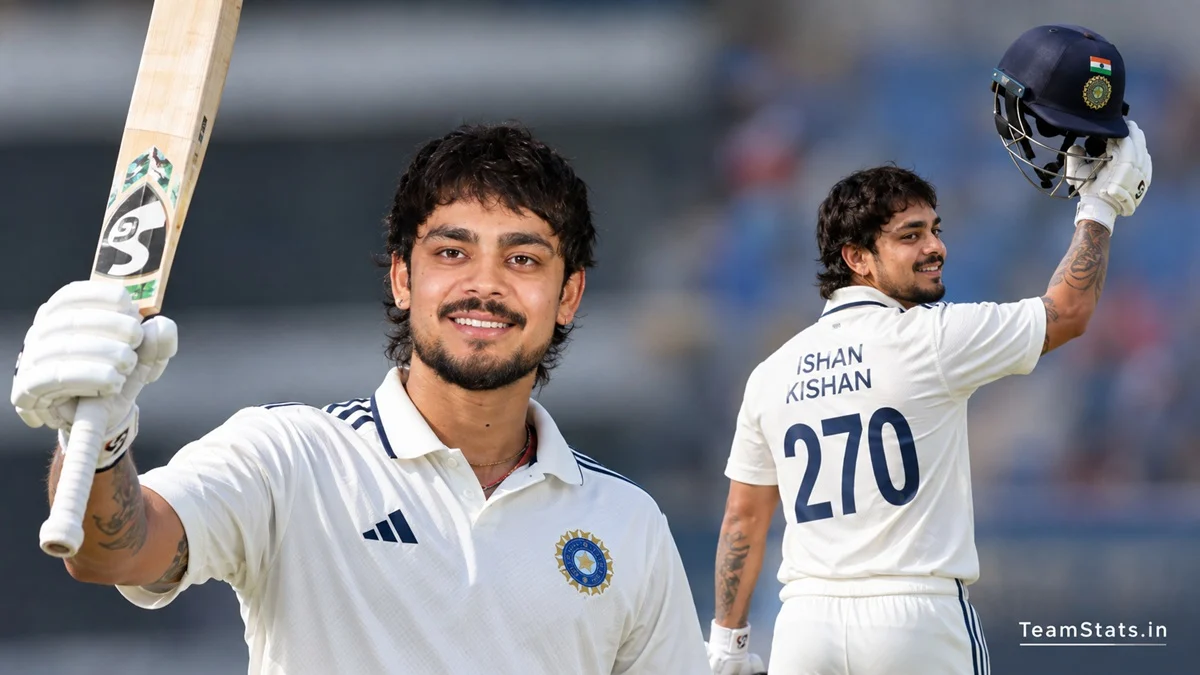
South Zone vs East Zone Duleep Trophy Final 2026: Ishan Kishan’s Epic 270 Puts East Zone in Command
The South Zone vs East Zone Duleep Trophy Final 2026 has turned into an extraordinary showcase of red-ball batting, with East Zone captain Ishan Kishan producing an innings that could be remembered for years.
Kishan scored a magnificent 270 from 334 balls, hitting 30 fours and seven sixes, as East Zone piled enormous pressure on South Zone at the MA Chidambaram Stadium in Chennai.
It was far more than just another big domestic hundred.
Kishan converted his overnight century into his maiden first-class double hundred, crossed 4,000 first-class runs during the innings and rewrote several Duleep Trophy final records along the way. His marathon effort was complemented brilliantly by Kumar Kushagra, who scored 101 from 132 balls, while Shikhar Mohan contributed 85 and Abhimanyu Easwaran made 72.
Even before Kishan took complete control, East Zone had made their intentions clear through an aggressive opening partnership featuring Easwaran and teenage sensation Vaibhav Sooryavanshi.
By the time Kishan was finally dismissed for 270, South Zone had spent the better part of two days trying to find a way through an East Zone batting line-up that simply refused to release the pressure.
South Zone vs East Zone Duleep Trophy Final 2026 – Match at a Glance
| Match Detail | Information |
|---|---|
| Match | East Zone vs South Zone, Duleep Trophy Final 2026 |
| Venue | MA Chidambaram Stadium, Chennai |
| Date | September 6–10, 2026 |
| Toss | East Zone won the toss and chose to bat |
| East Zone Captain | Ishan Kishan |
| South Zone Captain | Tilak Varma |
| Ishan Kishan | 270 off 334 balls |
| Kumar Kushagra | 101 off 132 balls |
| Shikhar Mohan | 85 off 120 balls |
| Abhimanyu Easwaran | 72 off 86 balls |
| Vaibhav Sooryavanshi | 44 off 37 balls |
South Zone vs East Zone Scorecard Today: Ishan Kishan’s 350-Run Final Masterclass
Ishan Kishan Turns the Duleep Trophy Final Into His Stage
There are hundreds that help a team.
There are double hundreds that dominate a match.
And occasionally there are innings that change the entire story surrounding a player.
Kishan’s 270 belongs much closer to the third category.
East Zone were not in serious trouble when their captain arrived, but South Zone had created their best opening when the score slipped to 147/3.
That was the moment when the final could still have changed direction.
Instead, Kishan shut the door.
The left-hander did not treat the situation like a limited-overs assignment. He was prepared to leave, defend and wait, but whenever South Zone’s bowlers missed their lengths, he had enough power to punish them.
Kishan had finished Day 1 unbeaten on 111.
On Day 2, the century became a double century.
The double century became 250.
And after initially leaving the field because of physical discomfort, Kishan returned and stretched the innings all the way to 270.
His final numbers underline the scale of the performance:
270 runs
334 balls
30 fours
7 sixes
Strike rate: 80.84
Tripurana Vijay eventually ended the innings, with Smaran Ravichandran completing the catch.
But by then the damage was enormous.
From 147/3 to Complete Control
One number explains why Kishan’s innings mattered even more than the final score suggests:
147/3.
South Zone had dismissed Sudip Kumar Gharami for six and had an opportunity to expose the rest of East Zone’s middle order.
Instead, Kishan built the innings that changed the match.
First came his partnership with Shikhar Mohan.
Mohan’s 85 from 120 balls was an important innings in its own right. The 21-year-old struck nine fours and three sixes and showed enough patience to ensure South Zone could not build momentum after taking wickets.
Mohan eventually dragged a Chama Milind delivery onto his stumps, falling only 15 runs short of a century.
His dismissal brought Kumar Kushagra together with Kishan.
That partnership became the defining phase of East Zone’s innings.
Ishan Kishan and Kumar Kushagra Add 230 Runs
Kishan and Kushagra put together a huge 230-run partnership for the fifth wicket.
Consider where it started.
East Zone were 241/4 when Kushagra joined his captain.
By the time South Zone finally separated them, the score had reached 471/5.
In one partnership, East Zone added 230 runs and dramatically changed the demands of the final.
Kushagra was not merely surviving at the other end while Kishan accumulated runs.
He attacked.
His 101 came from 132 balls and included eight fours and five sixes.
That strike rate of 76.52 was especially useful because it prevented South Zone from simply bowling defensively at Kishan and waiting for pressure to build at the opposite end.
Kushagra’s century was eventually ended by Tripurana Vijay, but the job had already been done.
Two wicketkeeper-batters from Jharkhand had effectively taken control of the Duleep Trophy final together.
Ishan Kishan Creates Duleep Trophy Final History
Kishan’s 270 is historically significant for several reasons.
He became the first East Zone batter to score a double century in a Duleep Trophy final.
Before this innings, Wriddhiman Saha’s 170 against Central Zone in the 2012 final had been the highest individual score by an East Zone batter in the tournament’s title match.
Kishan did not merely pass that record.
He moved 100 runs beyond it.
He also surpassed Dinesh Karthik’s 183 for South Zone against West Zone in the 2010 final, previously the highest score by a wicketkeeper in a Duleep Trophy final.
That makes Kishan’s innings particularly unusual: captain, wicketkeeper and double-centurion in the same final.
Kishan reached his double hundred from 270 deliveries.
Interestingly, 270 eventually became his final score as well, although he required another 64 deliveries to move from 200 to 270.
Where Does Kishan’s 270 Rank Among Duleep Trophy Final Scores?
Kishan’s innings now sits among the greatest individual performances produced in a Duleep Trophy final.
Some of the famous scores in the competition’s summit clash include:
| Player | Score |
|---|---|
| Raman Lamba | 320 |
| Ishan Kishan | 270 |
| Yashasvi Jaiswal | 265 |
| Cheteshwar Pujara | 256* |
| Mansoor Ali Khan Pataudi | 200 |
That means Kishan’s 270 moved him beyond Yashasvi Jaiswal’s 265 and Cheteshwar Pujara’s unbeaten 256.
Only Raman Lamba’s monumental 320 stands above Kishan among these leading Duleep Trophy final innings.
For a competition with such a long history, reaching that territory is a major achievement.
Kishan Falls Just Short of His First-Class Best
There was another landmark within touching distance.
Kishan’s career-best first-class score is 273, made for Jharkhand against Delhi during the 2016–17 Ranji Trophy.
He finished this innings on 270.
Just three runs separated him from equalling his career-best.
Four more would have produced a new personal record.
That near miss hardly reduces the importance of the innings, but it gives the 270 an interesting footnote: one of Kishan’s greatest first-class knocks stopped just short of becoming statistically his biggest.
A Different Side of Ishan Kishan
Kishan’s reputation has often been built around explosive batting.
His ODI double century against Bangladesh remains one of the clearest examples of what he can do when allowed to attack.
This innings required something different.
A 334-ball stay in a five-day domestic final demands concentration, fitness and patience in addition to stroke-making ability.
The 30 fours and seven sixes demonstrate that Kishan never abandoned his natural aggression.
But scoring 270 in 334 balls also required him to manage long periods when boundaries were not available.
That balance is what made the innings valuable from a red-ball perspective.
He did not simply overwhelm South Zone.
He outlasted them.
Vaibhav Sooryavanshi Gives East Zone a Flying Start
Before Kishan took over, Vaibhav Sooryavanshi had already given the final an aggressive opening.
The young left-hander scored 44 from only 37 deliveries, including five fours and a six.
His strike rate of 118.92 was the highest among East Zone’s major contributors.
Sooryavanshi and Abhimanyu Easwaran added 100 for the opening wicket, giving East Zone precisely the foundation they wanted after choosing to bat.
Sooryavanshi was eventually caught by substitute Tanay Thyagarajan off Chama Milind.
The dismissal prevented him from converting another promising start, but his approach had already forced South Zone onto the defensive.
Abhimanyu Easwaran Adds an Important 72
While Sooryavanshi attacked, Easwaran provided experience at the opposite end.
He scored 72 from 86 balls, with ten fours and a six.
The opening pair reached 100 in only 14.4 overs, an unusually rapid beginning for the first innings of a major five-day final.
Easwaran was eventually run out after a combination involving Narayan Jagadeesan and Devdutt Padikkal.
His departure made it 133/2, but East Zone had already established a platform from which their middle order could dictate terms.
Shikhar Mohan Misses a Century but Plays a Crucial Hand
Shikhar Mohan’s 85 could easily disappear beneath Kishan’s 270 and Kushagra’s hundred.
It should not.
Mohan faced 120 balls and struck nine fours and three sixes.
More importantly, he batted during the period when South Zone briefly threatened to drag themselves back into the final.
After East Zone lost three wickets, Mohan’s partnership with Kishan ensured that a promising opening did not turn into a middle-order collapse.
He eventually fell to Chama Milind at 241/4.
The century was missed, but the innings had already served its purpose.
Anukul Roy and the Lower Order Keep South Zone in the Field
East Zone’s batting did not end with Kishan and Kushagra.
Anukul Roy contributed a patient 45 from 98 balls, ensuring the lower middle order continued consuming deliveries.
Md Kounain Quraishi then added 40 from 91 balls, while Mohammed Shami chipped in with 28 from 51 deliveries.
Those may appear modest beside 270 and 101.
In the context of a first innings that had already exhausted South Zone’s attack, however, every additional partnership mattered.
The longer East Zone remained at the crease, the more difficult South Zone’s route back into the final became.
South Zone Bowlers Endure a Brutal Test
South Zone entered the final with a bowling attack containing Mohammed Siraj, Chama Milind, Tripurana Vijay and Shreyas Gopal.
East Zone made them work for virtually everything.
Siraj, in particular, endured an unusually difficult spell during the first part of the innings. At one stage he had conceded 118 runs from 21 overs without taking a wicket.
On a batting-friendly Chennai surface, the East Zone batters refused to allow South’s biggest pace threat to control the game.
Chama Milind provided important breakthroughs, including Sooryavanshi and Mohan.
Tripurana Vijay emerged as South Zone’s most productive wicket-taking option and eventually dismissed Kishan after also removing Gharami and Kushagra.
Shreyas Gopal added lower-order wickets as South Zone finally began working through the tail.
But the central problem was not simply a lack of wickets.
It was how long South Zone had to wait between them.
Why the 230-Run Partnership May Decide the Final
The partnership between Kishan and Kushagra deserves to be viewed as more than a statistical milestone.
At 241/4, South Zone still had a plausible route back.
One wicket could have exposed East Zone’s lower middle order.
Instead:
241/4 became 471/5.
That 230-run swing fundamentally changed the match.
South Zone were no longer thinking only about dismissing East Zone cheaply.
They were facing a first-innings mountain while also having spent hours in the Chennai heat.
That creates two forms of pressure.
The obvious one is scoreboard pressure.
The second is physical.
Long first innings can reduce the freshness of a batting side even before it begins its own innings, particularly when key batters have spent significant time fielding.
What South Zone Need to Do From Here
The scale of East Zone’s first innings means South Zone’s first target is simple: bat time.
Trying to erase such a huge total quickly would create unnecessary risk.
South Zone possess enough batting quality through Narayan Jagadeesan, Devdutt Padikkal, Tilak Varma, Ricky Bhui, Shaik Rasheed and Smaran Ravichandran to produce a substantial reply.
But partnerships will matter far more than individual bursts.
East Zone also have a highly experienced pace combination in Mohammed Shami and Mukesh Kumar.
If the pitch begins offering greater assistance as the match progresses, surviving the new ball becomes especially important.
Tilak Varma’s role as captain and middle-order batter could therefore become central to South Zone’s response.
East Zone Have More Than Runs on Their Side
A massive first innings gives East Zone obvious control, but the advantage extends beyond the scoreboard.
They now have several strategic options.
Kishan can attack with Shami and Mukesh when the ball is new.
He can turn to Anukul Roy as the surface wears.
And most importantly, East Zone do not need to force the game immediately.
South Zone are the team required to respond to the scoreboard.
That changes shot selection.
A delivery that a batter might normally attack suddenly carries greater consequences when the team is hundreds of runs behind.
This is why enormous first-innings totals are so powerful in multi-day cricket.
They change not only the score but the psychology of the innings that follows.
East Zone Chasing a Long-Awaited Duleep Trophy Title
There is another reason this performance matters.
East Zone have waited a long time to return to the top of the Duleep Trophy.
Their previous title came in 2012–13, when they shared the trophy with Central Zone after the final ended without an outright winner.
Fourteen years later, Kishan’s team now has an opportunity to write another chapter.
That context makes the captain’s 270 even more meaningful.
It was not accumulated in an early league match with little at stake.
It came in the final.
South Zone vs East Zone Final: Key Performers
Ishan Kishan – 270
The innings of the match so far. Kishan combined endurance with controlled aggression, struck 37 boundaries and produced one of the highest scores ever recorded in a Duleep Trophy final.
Kumar Kushagra – 101
A superb supporting century. His 230-run stand with Kishan transformed East Zone’s strong position into a dominant one.
Shikhar Mohan – 85
Missed a century but provided stability during an important stage of the innings.
Abhimanyu Easwaran – 72
Helped establish the match with a rapid 100-run opening partnership.
Vaibhav Sooryavanshi – 44
A short but aggressive innings that immediately placed South Zone under pressure.
Tripurana Vijay
South Zone’s key wicket-taker during a punishing innings and the bowler who eventually removed Kishan for 270.
Five Numbers That Tell the Story
270 – Ishan Kishan’s final score.
334 – Balls faced by Kishan.
37 – Boundaries in Kishan’s innings: 30 fours and seven sixes.
230 – Kishan and Kushagra’s fifth-wicket partnership.
3 – Runs by which Kishan fell short of equalling his first-class career-best 273.
Those numbers explain why this final has already become one of the standout matches of Kishan’s domestic career.
Is Ishan Kishan’s 270 Important for His India Red-Ball Ambitions?
One domestic innings cannot determine an international selection.
But performances of this size are difficult to ignore.
The most encouraging aspect for Kishan is not simply that he scored heavily.
It is how he scored those runs.
He batted for 334 deliveries in a major final, rebuilt after East Zone lost wickets, formed a 230-run partnership, battled physical fatigue and still maintained a strike rate above 80.
For a player whose white-ball hitting is already well established, demonstrating the ability to occupy the crease for such a long period strengthens the red-ball side of his case.
Selectors will ultimately judge a broader body of performances, team requirements and competition for places.
But a 270 in a Duleep Trophy final is exactly the kind of innings that keeps a player’s name in that conversation.
South Zone vs East Zone Duleep Trophy Final 2026: What Happens Next?
The equation is now very different from the one South Zone faced at the toss.
East Zone have converted the advantage of batting first into a massive first-innings platform.
South Zone’s response will determine whether this remains a contest or turns into a battle for survival.
The opening phase against Shami and Mukesh Kumar could be crucial.
If South Zone can establish a major opening partnership and preserve wickets, the excellent batting conditions at Chennai could still give them a route into the game.
Early wickets, however, would allow East Zone to turn their enormous total into suffocating scoreboard pressure.
Final Takeaway
The South Zone vs East Zone Duleep Trophy Final 2026 may ultimately produce several more twists, but Ishan Kishan has already given it a defining performance.
His 270 from 334 balls, featuring 30 fours and seven sixes, was an innings built on far more than attacking talent.
It required patience.
It required concentration.
And after East Zone briefly slipped to 147/3, it required leadership.
Kumar Kushagra’s 101, Shikhar Mohan’s 85, Abhimanyu Easwaran’s 72 and Vaibhav Sooryavanshi’s rapid 44 ensured this was not a one-man batting effort, but Kishan was unquestionably the player who transformed a strong East Zone innings into an imposing one.
For South Zone, the challenge is now enormous.
For East Zone, a long-awaited Duleep Trophy title has moved considerably closer.
And for Ishan Kishan, 270 in a Duleep Trophy final is the kind of innings that will remain on his first-class résumé for a very long time.
FAQs
How many runs did Ishan Kishan score in the Duleep Trophy Final 2026?
Ishan Kishan scored 270 runs from 334 balls for East Zone against South Zone, hitting 30 fours and seven sixes.
Who scored a century for East Zone besides Ishan Kishan?
Kumar Kushagra scored 101 from 132 balls, including eight fours and five sixes.
How many runs did Vaibhav Sooryavanshi score in the final?
Vaibhav Sooryavanshi scored 44 from 37 balls, with five fours and one six.
Where is the South Zone vs East Zone Duleep Trophy Final being played?
The match is being played at the MA Chidambaram Stadium in Chennai.
Who won the toss?
East Zone won the toss and elected to bat first.
What was Ishan Kishan’s partnership with Kumar Kushagra?
Kishan and Kushagra added 230 runs for the fifth wicket, taking East Zone from 241/4 to 471/5.
What is Ishan Kishan’s highest first-class score?
Kishan’s first-class career-best is 273, meaning his 270 in this final finished just three runs short of equalling that mark.
Who is captaining South Zone in the Duleep Trophy Final 2026?
Tilak Varma is captaining South Zone, while Ishan Kishan is leading East Zone.
- North Zone vs South Zone Duleep Trophy: From 80/5 to Final
- East Zone in Duleep Trophy Final After 14 Years
- Duleep Trophy 2026 Semi-Final Latest Update
- Vaibhav Sooryavanshi Duleep Trophy Captain: 15-Year-Old Smashes 42-Ball Fifty a Day After Leading East Zone

Related Posts
Sri Lanka vs Nepal Playing 11: Probable XI and Team News for Asian Games Quarter-Final

Bangladesh vs Malaysia Playing 11 & Playing XI: Probable Teams for Asian Games 2026 Quarter-Final

Sri Lanka vs Nepal Pitch Report: Korogi Sports Park Records, Weather & Asian Games 2026 Quarter-Final
India vs Afghanistan Playing XI: Match Abandoned, India Reach Asian Games 2026 Semi-Final
David Miller 142 vs Australia: Career-Best Century Powers South Africa to ODI Series Win